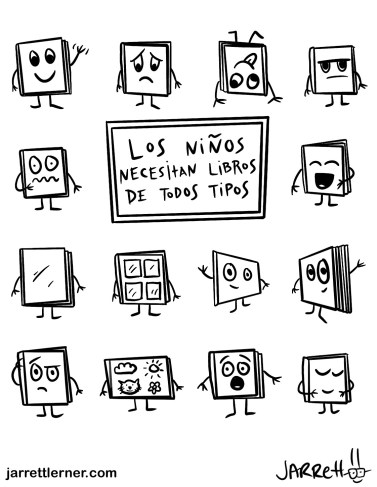
Last week, a third-grade teacher in a Spanish immersion school asked me if I’d ever consider making a Spanish language version of my Kids Need Books of all Kinds art. I thought it was a fantastic idea, and as soon as she assured me I had the right translation (!), I whipped it up.
(And, by the way, you can now download a free, print-ready copy of that art here.)
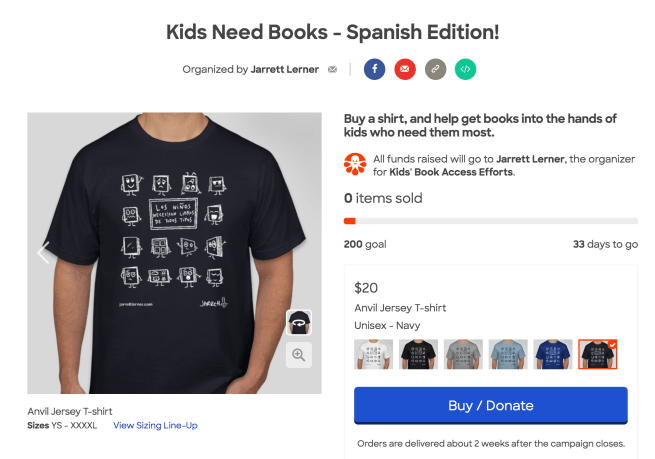
Not long after I put the new art up on social media, people started asking whether they’d be a new, Spanish edition sale of T-shirts, too. I said that if there was sufficient interest, I’d work with Custom Ink to set up a new, Spanish edition fundraiser (Custom Ink requires a certain number of sales before shirts can print, so I needed to make sure). Well, the interest was more than sufficient. And so, here you go!
The #KidsNeedBooks of all Kinds Spanish Edition T-shirt is now available! You can order it here. Thank you, thank you — a billion times over — to all who have shared and supported these efforts of mine. Together, we have raised over $23,000 to help eradicate book deserts and help get books into the hands of kids who need them most.
Once again, Kristen Picone, Kristin Crouch, and I spent a chunk of our summer poring over spreadsheets and playing matchmaker for hundreds of educators, librarians, authors, and illustrators for the second installment of the #KidsNeedMentors program. It was A LOT of work, and we’re not even quite done yet. But I think it’s safe to say I speak for Kristen and Kristin when I say that this is some of the most rewarding work we do. Getting to see the outcome of these partnerships — all the amazing, creative work they do together to benefit the kids — is tremendously satisfying, uplifting, and inspiring. If you want to see some of that stuff for yourself, I suggest you head over to Twitter or Instagram and search the #KidsNeedMentors hashtag. If you scroll back in time, you can see some of the awesomeness that occurred during last school year.
I’ll be sharing more about the program and the wonderful participants throughout the year, but now, at the outset, I’d like to highlight a couple of cool things:
— Last year, our creator list was mostly filled with authors from the United States. This year, we’ve got a whole bunch of illustrators, author-illustrators, comic book-markers, and graphic novelists. We also have lots of creators from Canada, and others who are in Australia, the Netherlands, Germany, South Korea, Austria, the Philippines, and the UK. We’ve also got educators and librarians in Zambia and Cambodia!
— My pairing for this year is Ms. Tilden’s 4th grade class at Brown School in Natick, Massachusetts. Now, the town of Natick is right next to Wayland — and that’s where I grew up. It’s where I made my very first comic books and wrote my very first short stories. It’s where I fell in love with books and reading. Meaning that, when I go to visit Ms. Tilden’s students, we’ll all be just a handful of miles from where, when I was their age, I was first beginning to dream of doing what I’m doing now. Pretty cool.
If you want to learn more about the #KidsNeedMentors program, click here for a blog post I did about it at the start of last year, and click here for an interview I did about it over on the From the Mixed Up Files of Middle Grade Authors blog. Also, once again, you can always search the hashtag!
You asked for it, so here it is: another chance to get a #KidsNeedBooks of All Kinds shirt. And look — new colors!
The original fundraiser only lasted two weeks, and many people either missed the deadline or couldn’t make a purchase during that time. Many people also expressed an interest in having some other color options. So, I worked with CustomInk to (a) re-launch a second, longer fundraiser and (b) add some new color options to the mix! As you can see below (and also on the fundraising page itself), there is now a black with white ink option, a military green option, a light pink with dark pink ink option, and an orange with white ink option.
The landing page for the fundraiser is the same as last time — you can click here to access it. One thing, however, that is a little bit different about this fundraiser: instead of all the funds going directly to First Book, a portion will go to them and a portion will be reserved for book donations to other school in need that do not qualify for First Book.
Once again, a big, huge, gigantic THANK YOU to everyone who has supported and/or shared the last fundraiser, and a big, huge, gigantic THANK YOU in advance to everyone who supports and/or shares this one. I am excited to learn more from First Book about exactly where the funds raised last round are going, and am excited to put whatever is raised this round toward getting more books into the hands of kids.
Oh! And if you already have a shirt (lots of people got theirs today!), don’t forget to post a #ShowMeYourShirt pic to enter to win some signed books and custom artwork!
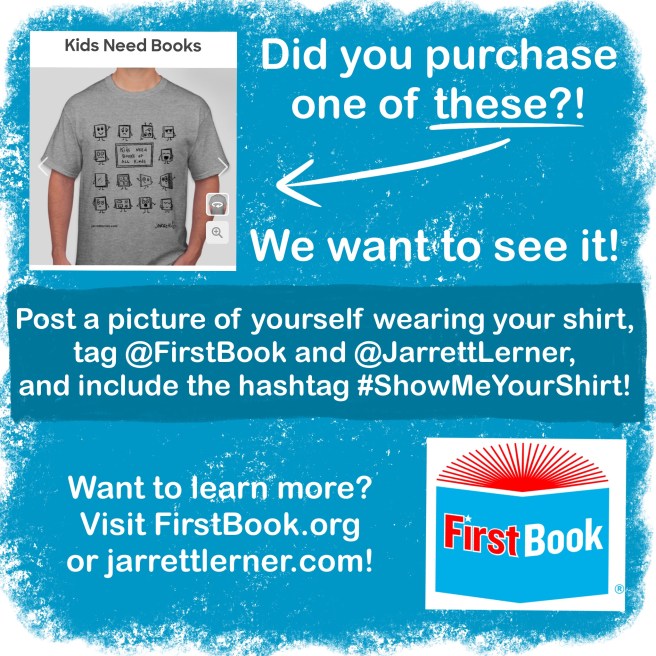
If you purchased one of my #KidsNeedBooks of All Kinds T-shirts, then you might’ve received an email from CustomInk earlier this morning letting you know that your shirt has shipped and is on its way to you (if you did not receive the email, you should within a couple days)! Hopefully you’re excited, because I’m excited, and FirstBook is excited too. They are so excited, in fact, they want to see you in your shirt! They asked me to help launch a #ShowMeYourShirt campaign.
Please note that the handle mentioned above is FirstBook’s Twitter handle. Their Instagram handle is @FirstBookOrg.
Taking part is as simple as putting on your shirt, snapping a pic, and posting it! Just make sure to tag me and FirstBook, and to use the #ShowMeYourShirt hashtag somewhere in your tweet or Instagram post. But wait, there’s more — one lucky #ShowMeYourShirt poster will win some signed books and custom artwork by me!
Thank you all again for your celebration of my art and your support of FirstBook. And if you didn’t get a chance to purchase a T-shirt and want one, I’ll have news in the coming days about how you can get one!
Before I visit a school, I always ask educators and administrators if there is anything in particular that they want me to share or discuss during my time with their students. Pretty much 100% of the time, they ask me to talk about revision — the importance of it and the reality of it, even for so-called “professional” authors and illustrators. Because, as a kid, I was under the impression that authors and illustrators always got it “right” on the first try, I already spent a lot of time during my presentations talking about revision. But during one visit a year or so ago, I had this thought — that I am just oneperson telling these kids about how writers should really be called “revisers,” because that’s mostly what we do, and about how every illustration you see in a book is the product of hours and hours and hours of work, of countless attempts. What if, after spending the day with me, the kids thought, “Well, that’s just how it is for that guy. But every other author and illustrator must get it right on the first try.”
How could I make sure this wasn’t the case? I got my pals to help me out! I asked kid lit authors to describe their first drafts for me using just one word. The responses were wonderful — and, of course, not a single creator said “perfect” or “polished” or “awesome” or “complete” or anything even remotely close to that. Frankly, the majority of respondents used the word “poop” (or some variation of it…). To share this information with kids, I made a quick drawing in my sketchbook, illustrating the words to make them more fun. This morning, I made a digital version of that drawing, so that educators could download a clean copy and use it as they wish.
Seeing this graphic, kids are always blown away — and, once they get over the fact that they are looking at the word “POOP” on a big screen, they feel encouraged and inspired to get back to their notebooks and sketchbooks and make some creative mistakes. Thank you to all the creators who responded to my original tweet all those months ago! To download a free copy of the graphic (and a number of others), head over to my Art page.
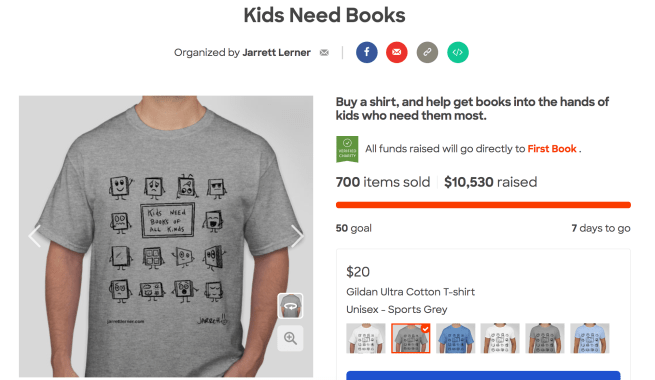
That’s right: as of this post, 700 shirts have been sold, and the $10,000 mark was surpassed yesterday afternoon — and there’s still a whole week of fundraising left! It helped, certainly, that both FirstBook and CustomInk have been sharing about the fundraiser across their social media platforms (and thank you again to CustomInk for featuring the fundraiser for #FundraisingFriday):
But more than anything else, the success of this campaign is because of two things:
1. The astounding generosity of the kid lit community (especially that of educators and librarians, who we know don’t get paid even close to enough for the incredible — and incredibly important — work they do).
2. The wonderful, wonderful work that FirstBook does.
Of course, these two things are linked. FirstBook is “a nonprofit supporting teachers and students in the USA’s highest-need communities with books and educational resources.”
So many of the people who have purchased shirts have left messages expressing gratitude to FirstBook and appreciation for their work and mission. (And if you are an educator, and you still aren’t totally sure what FirstBook does — and what it might be able to do for YOU! — I can’t encourage you strongly enough to visit their site and learn more.) I couldn’t be prouder to be playing a role in equipping FirstBook to continue providing their support to our country’s teachers and students. THANK YOU to everyone who has purchased a T-shirt and/or shared the fundraiser. I am sitting here flabbergasted and with a very full heart.
Recently, I made a digital version of my Kids Need Books of All Kinds artwork, just so those educators and librarians who were printing copies of it would have a cleaner, crisper version to use (you can download YOUR free copy of the art here).
Shortly after I shared the new art, elementary librarian Amy Timmins got it onto a T-shirt!
And it wasn’t long after that that people began suggesting I make some T-shirts of my own, and make them more widely available. A couple specifically said I should use CustomInk to make the T-shirt, as I could do so risk-free, avoid having to deal with shipping any of the shirts myself, and — most importantly — because I could direct any proceeds toward an organization of my choice! It seemed like a no-brainer, and right away I knew what organization I’d fundraise for: FirstBook.
If you don’t know about FirstBook and the incredible work they’re doing, I highly suggest you check them out — especially if you are an educator, librarian, administrator, or creator of books. I chose them because I knew that every single dollar that went their way would be spent getting the best books out there into the hands of the kids who need them most.
The response simply BLEW ME AWAY. Within two hours, we’d raised over $1,000. Within six, we were over $2,000! As of right now, we’re just shy of $2,500, and the fundraiser hasn’t even been live for a full day! And I say “we” because this is, of course, a group effort — one more example of the kid lit community coming together to do something good for the kids. Perhaps not for the particular kids in your classroom or library, but like my pal Ro Menendez, teacher-librarian at Cannaday Elementary School in Mesquite, Texas, likes to say, “ALL kids are OUR kids.”
THANK YOU to everyone who has purchased a shirt and who has shared the fundraiser on one social media platform or another. I appreciate it, as does FirstBook. A member of their team reached out to me this morning to let me know exactly that.
Click here to access the fundraising page and get yourself a shirt!
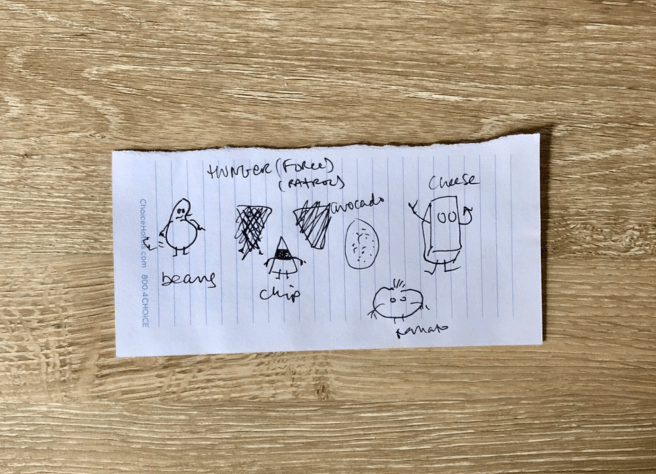
Last night, I finally shared the news that my graphic novel, HUNGER HEROES, will be out in the Fall of 2020. Today I want to share this:
This is the germ of the idea that would become HUNGER HEROES, scribbled and doodled on a piece of stationary from the Rodeway Inn in Hesston, Kansas (a hotel, I want to add, with one of the friendliest staffs I’ve ever met, plus a popcorn machine and a constantly restocked tray of hot, fresh, homemade cookies in the lobby).
This was last year, in 2018, and I was in Kansas for nErDCampKS. I often get my wildest, craziest, best ideas when I’m out of my creative routines and comfort zone. Add the energy and inspiration of nErDCamp to the mix, and it’s no surprise that I was getting some new story ideas. I’m just glad I had a pen and paper on me — though it’s rare that I don’t — and also that I took seven or eight seconds to get this idea down.
I try to do this anytime an idea comes to me. Nine times out of ten — or maybe even ninety-nine times out of a hundred — the idea doesn’t have the legs it needs to turn into a full-fledged story. But that’s just the way the creative process works: you log ninety-nine misses before you hit your target, you have to do something the wrong way ninety-nine times before you figure out how to do it right (or at least less wrong).
All of which is to say something that I’ve said plenty of times before: every now and then, make sure to intentionally shake up your routine. Get out of your comfort zone — and don’t forget to take a pen and paper along with you!
This past Saturday, in Chatham, NJ, I was honored to help launch nErDcampNJ by giving one of the day’s five opening nErD Talks — brief, TED-style talks aimed at energizing and inspiring the assembled educators and creators for a day of sharing, learning, and celebrating books. The text of my talk is below.
. . .
Photo taken by Josh Funk.
Many of you might already be familiar with the theory of narrative identity. But just in case you aren’t, the basic premise is this: that individuals form an identity by integrating their life experiences into an internalized, evolving story of the self that provides the individual with a sense of unity and purpose in life.
All of which is just a fancy way of saying that we are stories, and that we rely on those stories, deeply. Strands of narrative course through our minds and imaginations, and they are just as instrumental in making us us as our DNA.
So the story my parents like to tell about me coming home from school one day and demanding they remove the training wheels from my bike, so determined was I to learn how to ride on two wheels – that’s me.
And all the stories my siblings like to tell about me nagging them, stubbornly refusing to leave them alone until I got what I wanted from them – those are all me, too.
Back in elementary school, there were some kids who liked to tell a story about me being fat, and about how, because of that, I was somehow less than, and ought to be ashamed of my body and myself. There were only a few of these kids. But they were loud, and persistent. They told that story again and again and again and again. It didn’t take long for me to memorize it. Soon enough, I started telling that story too. There were days, back then, when the Book of Myself contained that story alone, printed ten, twenty, a hundred, a thousand times.
Of course, we aren’t born with the ability to tell our own stories. And so just as we must rely on others for food and shelter, we rely on others to fill our fresh, malleable minds with story.
Our primary caregivers, whether they’re parents, grandparents, aunts and uncles, siblings, neighbors, or the staff at a foster care facility – they have the honor and enormous responsibility of filling us up with the very first stories of ourselves.
Later on, teachers and coaches help do this, as do our peers. For a while, the stories our peers tell about us tend to become the loudest and the largest, looming in our minds and imaginations, bolstering us up, and other times, holding us down.
Eventually, we tune into the society and culture at large. And adults too often assume that kids aren’t paying attention, or that they aren’t even capable of understanding what’s going on around them. But they hear. They see. They listen. They understand. They’re exposed to all of it – the good, the bad, and the ugly. And there’s a lot of ugly out there these days.
Fortunately for me, I was filled up with good, hopeful stories about myself from my first day on this planet. I had a pair of loving, supportive parents who constantly told me stories about how wonderfully unique and impressive I was. I had teachers who told me stories about how smart and creative and hard-working I was, and how I had a very bright future ahead of me, and how they cared about my wellbeing and success. I had friends who told stories about me being cool and funny and fun to be with. And I was also extremely fortunate to have books – more than I could ever possibly read – that featured kids who looked just like me and came from backgrounds basically identical to mine, and anytime I wanted, I could live vicariously through their stories, and allow them to animate and inspire me.
And all of these stories – they didn’t just sit there in my head, static and silent. They were like the songs on a constantly shuffling playlist. They were the soundtrack to my life. And pretty much anytime I wanted, I could grab the controls and be the DJ – I could play a story that I wanted or needed to hear on a loop. I could reread it, so to speak.
And so, when I was struggling with a difficult assignment, when I faced a situation in which I was forced to choose right from wrong, or when I was just having a crummy day, I had all those people, all those storytellers, right there with me, reminding me of whatever I needed to be reminded of.
By the time I was eleven or twelve, I was no longer passively accepting the stories that came my way, whether they were about me or about others. I had become a conscious, critical consumer of story – my parents and teachers had helped turn me into a reader. And so when I encountered a narrative that, for one reason or another, didn’t sit right with me, I had the wherewithal and the tools to question it, to perform the sort of textual examination on it that I would on any short story, poem, or novel. So when someone once told me that, because I was Jewish, I must be good at tricking people out of money, I was able to prevent that story from doing me lasting harm. And it wasn’t long after that, in the fall of 2001, that I began to see people on TV and hear them in the grocery store telling stories about how all the people from this country or of that faith were one terrible thing or another, and I was able to pick apart those narratives and understand them to be abhorrent, ridiculous, and ignorant.
It was also around this time that my parents and teachers helped me become a writer – helped me embrace my passion for story and develop my skills as a storyteller. And just as I wrote fiction about talking animals and alien invasions, I constructed new narratives for myself. I was able, for instance, to craft healthier stories about my appearance, and so develop healthier responses to the swirl of negative emotions that those body-shaming bullies had buried in me years before. And eventually, finally, I was able to imagine a story for myself in which I not only chased my dream, but began to live it.
Photo taken by Nikki Mancini.
It’s because of all those good, positive stories about myself that I was filled with as a kid that I made it through the countless trials and tribulations of growing up. It’s because of all those good, positive stories about myself that I was filled with as a kid that I possess empathy, and that I look for the good and positive in others and in most every situation. It’s because of all those good, positive stories about myself that I was filled with as a kid that I eventually became able to write new stories about myself, and that I believe, deeply, that my life has a purpose.
Now, if your mind hasn’t leapt there already, I ask you to take a moment to consider the kid who isn’t filled up with all of those good, hopeful, positive stories about themselves – or even more tragically, the kid who is filled up with nothing but negative narratives. Ones telling them that they’ll never amount to anything. That their future is bleak, or worse, nonexistent. That they don’t belong. That they don’t have anything of value to give. That they’re dangerous. That they are, somehow, inherently bad . . .
It isn’t just the future authors and English teachers who need to be strong readers and writers – it’s every child. Strong readers and writers make for confident, capable, resilient human beings who know that their lives matter, that their voice is uniquely valuable, that their stories are as worthy of being heard as anyone else’s. Readers reflexively question narratives that come their way. They interrogate others’ stories before they allow them to add to or subtract from their sense of self or somehow alter their worldview. And writers? Writers are open to the limitless potential both within themselves and surrounding themselves. They don’t look in the mirror or at the world around them and say, “Well, I guess this is it.” They look and they wonder, “What if . . . ?”
As a maker of stories for kids, as a member of this kid lit community, I believe it is my job to help create and promote the kinds of books that ALL kinds of children both want and need, so that they enjoy and appreciate story enough to be motivated to become the strong readers and writers that they need to be, and so that even if they aren’t being told good, hopeful, positive stories about themselves by the people in their lives or by portions of the society and culture at large, they have a chance to discover such stories in books.
I also believe that, simply because I am a creator of some of those stories that kids read, I have a unique opportunity to inspire the sort of excitement around reading and writing that can further help turn kids into the strong readers and writers that they need to be. I do that by visiting schools, by Skyping with classrooms and libraries, by answering emails from readers, by writing back to the letters kids send me, by spending time interacting on FlipGrid pages, by tweeting, and by helping organize initiatives such as #KidsNeedBooks and programs such as #KidsNeedMentors, through which we’ve connected hundreds of creators with thousands of kids all over the country and even the world.
Lastly, I believe that part of my job is to work with all of you – educators, librarians, administrators. And that’s why I’m very excited to be here today, at nErDcamp. I love nErDcamp. I go to every single one I can – here in New Jersey, on Long Island, in Kansas, in Vermont, in Michigan, in Maine. There is nothing like the energy and spirit of nErDcamp. Because camp celebrates and puts into highly productive practice the belief that kids’ educators and kids’ book creators are colleagues, and that, at the end of the day, our core mission is the same: to improve and enrich the lives of kids through books – to fill them up with as many good, hopeful stories as we can, and to help them learn to value, and craft, and proudly share stories of their own, whether they’re full of flights of fictional fancy or about themselves, chasing and achieving their deepest, wildest dreams. The more we all work together, the better work we can all do.
So, let’s get to work. Let’s talk about reading and writing and books. Let’s listen to one another, and share with one another, and learn from one another, so we can all leave here more inspired, energized, and better able to help our kids.
. . .
The four speakers I shared the stage with are some of the most amazing individuals I’ve had the honor of meeting and learning from — Tricia Ebarvia, Emma Otheguy, Andrea J. Loney, and Laurie Halse Anderson. They have all, in some form or another, shared parts of their talks on their social media feeds and/or websites. I highly encourage you to seek them out, and if you have yet to do so, to take a look at the wonderful, important work they are all doing.
To learn a bit more about what nErDcamp is, take a look at this blog post I did a while back. (Since I’ve written it, a new camp has been launched in Southern California, and a few more are in the early planning stages in Central New York, Pennsylvania, and Maryland.)
Research shows that when kids own books, they read more and are more likely to self-identify as readers. It also shows that when kids don’t read during their summer breaks, their reading skills can get rusty and their interest in books can wane.
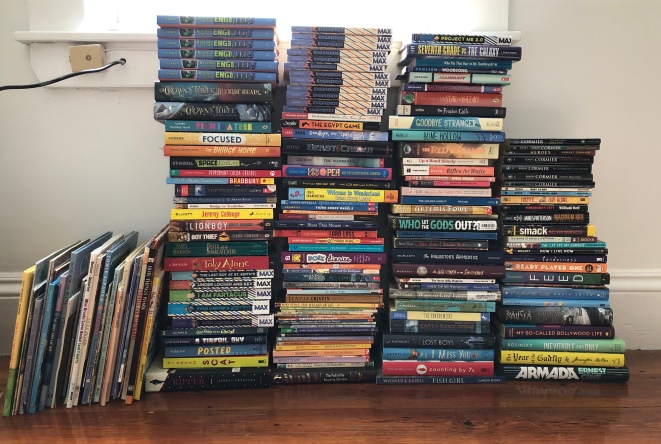
One of the largest reasons why kids don’t read during their summer breaks is that they simply don’t have access to any books. In an effort to counteract that problem in some small way, I’ve been giving away books all school year long as part of the #KidsNeedBooks movement and, in addition, gathering a separate bundle of books to now, at the end of the year, distribute to a couple hundred kids.
Where did I get these books?
Some of them are from my own personal collection – books that I have read and enjoyed (even loved!) but can’t, deep down, see myself ever rereading. In kids’ hands, these books are powerful. Some of them are powerful enough to dramatically redirect and improve lives. On my shelves, these same books can only ever hope to look nice. (And I’m not knocking hanging onto books for their looks or the comfort of just having them around. Believe me – I still do plenty of that!)
The majority of the books, however, I’ve gotten elsewhere: at library sales (the sales my local branch holds has paperbacks for 50 cents, hardcovers for a dollar); in bookstores’ used, “hurt,” and remaindered bins or sections; from friends (including some very generous author friends!) and neighbors; and at yard sales.
I share all of this not because I want a pat on the back. I don’t. And honestly, none of this has been hard work. It’s been an absolute joy to find these books, to stack them up in my closet and think about the kids who will soon hold them in their hands, who will be able to say, “This is my book. Mine.”
I share all of this to help alert those who aren’t aware of the book deserts throughout our country, who don’t grasp the long-lasting damage that can result from a kid simply not being able to get their hands on a book to read. I share it, too, in the hopes that some of you will be inspired to gather your own stacks of books, to keep an eye out for them in your comings and goings, to pick through your bookshelves or put 10, 15, 20 dollars toward bettering and maybe even dramatically changing some kids’ lives. I mean, could there be a better investment?
Should you want more information about any of the above, don’t hesitate to reach out to me, either here, using my Contact form, or on social media. To learn more about the #KidsNeedBooks movement, click here, or search the hashtag on social media. And if you are an educator who would be interested in sharing some of the books pictured above with your students, fill out THIS FORM. I will be randomly selecting winners to receive books over the coming weeks.










 Jarrett Lerner