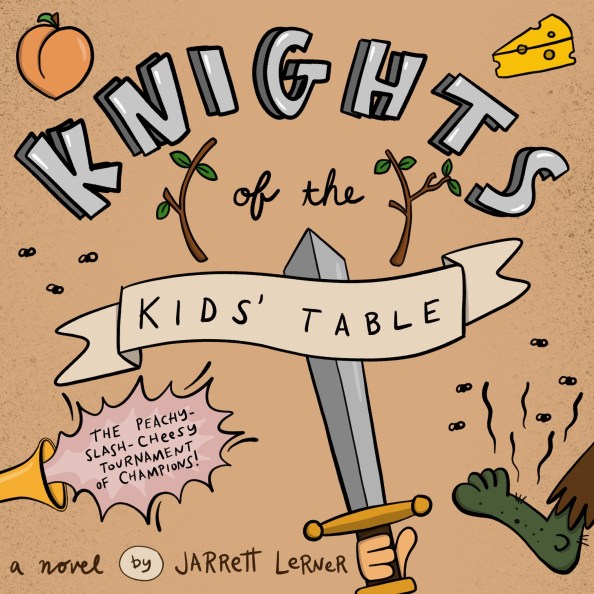
KNIGHTS OF THE KIDS’ TABLE: Chapters 15, 16, and 17

knights


Chapter 15


By the time the boys reached the castle, a small crowd had gathered on the lawn outside. There were men and women, boys and girls, all of them thin and sick-looking, their skin covered in layers of dirt and grime. Perched atop their horses, the boys were able to look down and see that the crowd was in fact huddled in smaller clumps of four or five, and that at the center of each group was a man, holding out a peach pie – one identical to those that the boys had just feasted upon out in the field. The men, scraggly and starved as could be, let the women and children have a turn scooping up a bite of pie first, and only then did they reach in for a taste themselves.

Gehry tried to get a better look at the people’s faces, wondering if each group was a family. But with all the dirt and grime caking their skin, it was hard to make out any particular features, and nearly impossible to then compare, say, the shape of a lip or the bend of a nose to the person’s beside them.

Kinsmere studied the castle. First the stones, then the ironwork, and finally the flag, bright white with a big peach painted in its center. And all of it – it looked so new. Kinsmere wouldn’t have been surprised to learn that the castle had been built just yesterday, that the flag – clean and white as a field of freshly fallen snow – had been raised for the first time that very morning.

Bruce, meanwhile, looked back and forth from the pie-eating people to the castle. He wanted to know where the cheese was. Because the thick, greasy scent of pressed milk curds was now stronger than ever. It swarmed Bruce’s head, making him feel dizzy and desperate. But he hadn’t found so much as a smear of the stuff when the castle doors flew open with a bang loud enough to make him forget all about it.

Out of the castle strode a group of men who couldn’t have been more different than the crowd assembled on the lawn. They were big and brawny and obviously well-fed. And save for a smudge of peach juice on a cheek and the stray flake of piecrust in one man’s hair, they were all clean, a few of them even immaculately so. They looked, in a word, like knights.

The last of the men to emerge was by far the biggest, brawniest, and best-fed of them all. When it came to cleanliness, however – well, that was another story. The man looked like he had gone for a swim in a lake of smooshed peaches. Chunks of the fruit were wedged in the linked rings of his chainmail shirt. His once-black boots were stained an orange-brown color by years’ worth of crusted peach juice.

The man was chewing, loud as a herd of cows, and had a wide, glistening circle of pulpy peachiness slathered around his mouth. Suddenly, then, he tossed his head back and spat a peach pit into the air. The boys, the dirt-covered crowd, and the clean, knightly men all watched and waited for the pit to fall back down to the ground. After a minute had passed and it still hadn’t, everyone began to clap, the crowd as enthusiastically as their weak bones would allow, the knightly men a bit begrudgingly.

The peach-covered man, grinning hugely, planted his hands on his hips and looked around the lawn. When he spotted the three neat, clean, well-dressed boys sitting on horseback amidst the bedraggled crowd, the man’s grin disappeared with a swiftness that could only be described as terrifying.

Aiming a peach-stained finger at the intruders, he demanded, “Who are you?”

Gehry urged his horse forward. “I am Gehry,” he said, “son of Beribahn, King of the Realm and eldest son of Galaghand and Handelhar, who was daughter of Baghagelbisn, overseer of the Great Siege of Curnaffleflaffer and son to the one and only Todd, brother of Ferghelwergel, otherwise known as – ” Pausing, he took a quick look around. “ – as the Giant Slayer, and also sometimes Fungi Foot, who led the uprising at Yarlamik, and once met Penlaghel, also known as the Crazed King, at a party.”

The big man squirmed his mouth around as if he were trying to poke something out from between his teeth. Leaning toward Gehry, he spit out another peach pit. It struck the ground, bounced, and rolled up to tap the hoof of Gehry’s horse.

That,” the man said, “is what I have to say about your royal lineage. Beribahn . . . ” He laughed. “He’s not the king of this realm.” He pointed down at his crusted-over boots and proclaimed, “This is my castle. My kingdom. For I am the Peachy Knight!”

The crowd once again clapped for the man, who, it was now clear to the boys, was some sort of rogue knight.

“Excuse me.”

It was Kinsmere, who had brought his horse forward so that he now sat beside Gehry.

“Did you say Peach-eee?”

“Uh, I – well, yes,” said the rogue knight. “Yes, I did. Peachy. Is there . . . why? What – what’s wrong?”

“Nothing.” Kinsmere shook his head. “It’s just – I figured – I thought you said Peach, that’s all.”

“You thought or you figured?” asked the rogue knight.

Kinsmere considered the question. Then he began to nod. “I guess I figured, yeah.”

The rogue knight frowned.

“No,” Kinsmere told him. “It’s not, like, bad that way. It’s just a little, I don’t know, strange, I guess? It’s different. You know, like when I hear ‘peachy,’ I’m not really thinking ‘knight’ is gonna come next. I’m more ready to hear something like – like ‘lady,’ I guess.”

The crowd let out a collective gasp, and the Peachy Knight’s eyes got as big as fists.

Kinsmere shook his hands as if he were trying to scrub away what he had just said. “Hold on,” he said. “Wait. I didn’t – I didn’t mean it like that. I wasn’t saying anything about you. I was just curious, that’s all.”

This seemed to quell, and also confuse, the rogue knight. “Curious?” he said, as if this were his first time encountering the word.

“Yeah,” Kinsmere said. “I was wondering, I guess. I mean, why not just leave it at Peach?”

The rogue knight winced a little, and sighed, and then, in the pinched, whiny voice of a child who has realized too late that he chose the worst of the desserts at a feast, he said, “I was gonna do Peach, but then I started doubting myself. I was all worried. Like, you know, is that right? Is Peach correct? Because, you know, I’m not actually a peach.”

“Right,” Kinsmere said, nodding sympathetically.

“And – and then – ” Tugging up a sleeve of his chainmail shirt, the rogue knight stuck out his arm so Kinsmere could see. “Look. It’s not like my skin’s really peach-toned, either.”

“I see that,” Kinsmere said. He narrowed his eyes and leaned forward on his horse. “More of a . . . a sort of pale strawberry.”

“Really?” said the rogue knight, sounding touched. “You think?”

“Oh, yeah,” Kinsmere said. “For sure. I definitely see some strawberry in there.”

Turning over his arm in the sunlight, the rogue knight muttered, “I always thought it was kind of an ugly color.”

Stop that,” Kinsmere told him. “It’s a lovely color.” He looked back at the crowd. “Isn’t it lovely?”

There was some murmuring among the crowd. Individual voices could be heard here and there, saying things like, “Oh, yes,” and, “Yes, indeed,” and, “Very lovely.”

“See?” Kinsmere asked the rogue knight.

The man shrugged, sheepishly, as if he wasn’t quite convinced. “Anyway,” he said, moving on. “I ended up going with Peachy, on account of my liking peaches so much, plus cause I’m always eating ‘em. And if I’m not? Well, you can be sure at least I smell like ‘em. All of which led me to believe that the adjectival form was the proper one to use. The Peach-eee Knight, as opposed to just the Peach Knight. Otherwise people might show up looking for a knight with a complexion a little more orange than mine. Or, I don’t know – ” He shrugged again, and this time the gesture seemed almost cheery. “ – maybe even a great big peach on horseback, all suited up with a sword and shield.” The rogue knight smiled at the thought of this, then uttered a single syllable of laughter: “Ha.”

The instant they heard this, the crowd erupted, throwing their heads back and hooting up at the sky. Several women slapped their knees. A few men toppled to the ground, gripping their splitting sides.

The rogue knight looked their way, a small, shy smile on his face. He lifted a hand and gave a tiny wave. “Thanks,” he said. “Ha. Thank you, yeah.”

As he was taking in the adoring crowd, the rogue knight’s eyes once again settled on the boys, and his smile began to fade.

All of a sudden he blurted, “Who are you?”

Gehry cleared his throat. “Oh, ah – we did that one already. Remember?”

The rogue knight’s eyes got glassy. He was, it seemed, casting his mind back into his memories of a few minutes ago. Finally, blinking himself back into the present moment, he said, “Oh, right. Yeah. Of course. Thanks.”

Gehry gave a little nod. “No problem,” he said.

Taking a second to compose himself, the rogue knight started over. “What are you?” he said, but began to shake his head before all the words had even passed his lips. “No, no, no,” he muttered. “That’s not right. It’s . . . well, it’d have to be . . . Aha!” he cried, and in a proud, booming voice, he declared, “What are you doing here?”

There was some polite applause from the crowd.

Gehry waited for the clapping to stop, then gave the Peachy Knight the answer he knew he was supposed to give. “We are knights-to-be, and have been sent forth in search of adventure, hoping to prove ourselves worthy enough to return to my father’s castle and become proper knights, after which we shall spend our lives protecting the Realm from the evil influences that seek to threaten its continued existence and eternal glory.”

The rogue knight cupped a hand around his sticky mouth and quietly asked Gehry, “You said ‘adventure,’ right?”

“Yep,” Gehry answered. “Back there in the beginning.”

“Ha!” barked the rogue knight. “If it’s adventure you’re after, then you’ve come to the right place! For you’ve arrived at the castle of the Peachy Knight at the outset of the world-famous, semi-annual – ” He leaned back and, putting his whole body into it, bellowed up at the heavens: “PEACHY-SLASH-CHEESY TOURNAMENT OF CHAMPIONS!”

The crowd – by now, perhaps, feeling the bolstering effects of those sugar-packed pies – cheered louder than ever.

“You missed the first event,” the rogue knight told the boys. “But that was pie-throwing, and it’s not like any of you could have beaten me, anyway. Normally I wouldn’t even let sad sacks like you compete, but seeing as that so-called king sent you here himself, I’ll make an exception.” He licked his lips, collecting some of the juicy peach flesh stuck to his skin and quickly swallowing it. “You’ll spend the night in my castle, and compete tomorrow in the rest of the tournament’s events. And once you’ve been beaten, once you’ve been humiliated and shamed, you can run home and tell Beribahn that no one can match the greatness of the Peachy Knight. And if he doesn’t believe it? Well, I’ll launch a pie clear across his itsy-bitsy little realm so it smacks him right in his stupid, ugly face!”

Bruce, who had been silent this whole time, kicked his horse forward, putting himself closer to the rogue knight. “Um, hi,” he said. “I think I heard – did you say ‘cheesy?’”

“Yes,” said the man. “Peachy-slash-Cheesy. That’s the name of the tournament. That’s my brother.”

“Who is?” asked Bruce.

“The Cheesy Knight.”

“I see . . . ” Bruce said. “Is there any way we could meet him?”


Chapter 16


The boys didn’t get to meet the Cheesy Knight, and didn’t get to enjoy any of his fine-smelling cheese, either. Instead they were instructed to get off their horses, at which point a thin, dirt-caked child led them into the castle.

First, the child took them up a staircase. This came as a great relief to Gehry, who had assumed the Peachy Knight, rogue that he was, would force the boys to spend the night in his frigid cellar or, worse, some kind of dungeon. However, not long after the boys had been led up the staircase, they were led back down to the first floor by way of a different one.

Gehry fell back a few steps and leaned in close to his friends. “You think he knows where he’s going?” he asked them quietly.

Kinsmere shrugged. “Better than I do, at least.”

Bruce didn’t contribute to the conversation. In fact, he didn’t even hear his friends talking. He was busy, completely consumed in an examination of the walls of the corridors they were passing through, each of which had been decorated with various weapons and, it appeared, instruments of torture. There was a pair of giant metal jaws, spring-loaded, ready to snap and bite off a foot or a leg with its large, sharp teeth. There were thick whips, thin whips, and heavy ropes that had been wound around elaborate networks of gears, pulleys, levers, and wheels. There were swords and spears, lances and pikes, daggers and knives – essentially every kind of sharp, pokey-thing that history’s more violent metalworkers had ever conceived of. The objects put Bruce in such a dark and fearful mood that even the regular torches that lit the corridors began to look menacing.

When the boys’ guide took a turn into a long, bare-walled corridor, Bruce felt a rush of gratitude and relief. His head began to clear, and was quickly helped to clear even more by the sudden arrival of a lovely smell. Or smells, actually. Because the first scent swiftly gave way to another, and so on and so forth until Bruce couldn’t even tell what he was smelling. All he knew – and all he needed to know – was that it smelled glorious.

At last, the boys were led into a big, hot, busy kitchen. The sight of the place stopped not only Bruce in his tracks, but also Gehry and Kinsmere in theirs. The kitchen’s size and scope and level of frenetic activity rivaled even that of the one in King Beribahn’s castle.

Between and around the bodies darting about the place, the boys glimpsed a quantity of food that was, in a word, astonishing. There were blobs of dough the size of foals that were slowly inflating, growing larger, and larger still. There were cloth bags, enormous things whose tops nearly touched the ceiling, with words like “CINNAMON” and “ALLSPICE” and “CUMIN” and “CARDAMOM” printed on their sides. There were small mountains of sugar and flour, a sprawling heap of peaches – and in one corner, leaning carefully against the wall, a wheel of cheese humongous enough to make a troll-giant feel faint. The wheel was surrounded by a group of thin, tired-looking women whose job, it seemed, was to fan the cheese, thus preventing it from softening in the hot kitchen and losing its perfectly round shape.

“Psst!”

It was the boys’ guide, trying to get their attention. The child was already over on the opposite side of the kitchen. He waved at them to hurry up, and the boys went, dodging the charging bodies of bakers and cooks.

They were led out of the kitchen – Bruce lingering a moment in the doorway, casting a glance of longing back at the cheese – and into another corridor, at the end of which they went up two flights of stairs, turned a corner, and crossed yet another corridor. There, at last, the boys’ guide stopped. The child poked a finger at a small wooden door. It was so small, in fact, that the boys hadn’t even noticed it before their guide had pointed it out. In order to reach whatever lay on the other side, they would have had to get down on their hands and knees and crawl.

Which, it became clear, was exactly what the boys’ guide wanted them to do. The child poked again at the tiny door, this time more forecefully. Then he turned around and walked away.

Gehry, Kinsmere, and Bruce all watched him go. His feet made little shushing sounds on the stone floor, the noise bouncing back to the boys’ ears down the otherwise empty corridor. Once the child had disappeared around the corner, the boys turned back to the small door.

Kinsmere nudged it with the toe of his boot, and the door crept open with a creaky whine.

“Well, then,” he said.

He got down on his hands and knees and crawled on through.


Chapter 17


The room wasn’t as bad as that tiny door had led the boys to believe. But that’s not to say that it was big and warm and cozy. In fact, the room was just the opposite. Extremely narrow, with a gaping hole of a “window” at the far end and a pair of stacked wooden planks fastened to one wall, it was small and cold and uncomfortable.

Kinsmere, however, didn’t seem to mind.

“I call top bunk,” he said, hoisting himself up onto the higher of the two planks.

Gehry pointed to the other. “You take that one, Bruce. I don’t mind the floor.” To prove it, he lowered himself down onto the cold stones, leaned his head back against the wall, and shut his eyes.

“Whoa, whoa, whoa, whoa, whoa.”

This was Bruce. He was standing in the middle of the room, looking back and forth from one of his friends to the other.

“Wait a minute,” he said. “What about all that food?”

Gehry opened his eyes. “What about it?”

“I want some,” Bruce said.

From his perch atop the upper plank, Kinsmere chuckled.

“Don’t worry,” Gehry told Bruce. “I’m sure they’ll bring us something.”

Not two seconds later, there was a knock at the door. Bruce opened it and leapt back when a pair of scrawny, dirty arms thrust into the room, holding a pitcher of water in one hand and a loaf of bread in the other. The pitcher and loaf were dropped unceremoniously to the floor, at which point the arms disappeared as abruptly as they had arrived.

“That’s it?” Bruce cried out into the hallway.

But there was no answer. The owner of the scrawny arms was already gone.

Heaving a sigh, Bruce picked up the bread. “Hard as a rock,” he said, then banged the loaf against the wall to show his friends that he wasn’t exaggerating. A few crumbs broke off and sprinkled onto the floor, but otherwise the bread remained intact.

“Here,” Kinsmere said.

He hopped down off his plank and took the bread from Bruce. Smashing the loaf over his knee, he broke it into half a dozen more manageable pieces. He picked one up and plunked it into the pitcher of water. After letting it sit in the liquid for a few seconds, Kinsmere popped the softened piece of bread into his mouth.

“Mm, mm, mm.” He patted his stomach. “Delicious,” he said, reaching for another hunk of bread.

Bruce grabbed a piece for himself before his friend could eat the whole loaf. Dunking it into the water, waiting for it to soften, he said, “This is ridiculous.”

“The life of a knight,” Kinsmere said between chews, “isn’t all fanfare and feasts.” Soaking a third piece of bread, he tossed it over to Gehry.

“Thanks,” Gehry said, blinking down at the soggy thing in his palm.

It took the boys just a couple minutes to finish the bread. At which point Bruce asked, “What do we do now?”

“We get some sleep,” Gehry said. “Tomorrow’s a big day.”

Kinsmere grinned. “Our very first tournament.”

“Oh, joy,” said Bruce, his voice as unenthusiastic as Kinsmere’s was thrilled.

The boys passed the pitcher of water around until it was empty. Then they went to bed.

______

Text copyright © 2020 by Jarrett Lerner

All right reserved, including the right of reproduction in whole or in part in any form.

Draw the Author Contest: the WINNERS!

Draw the Author Contest Announcement

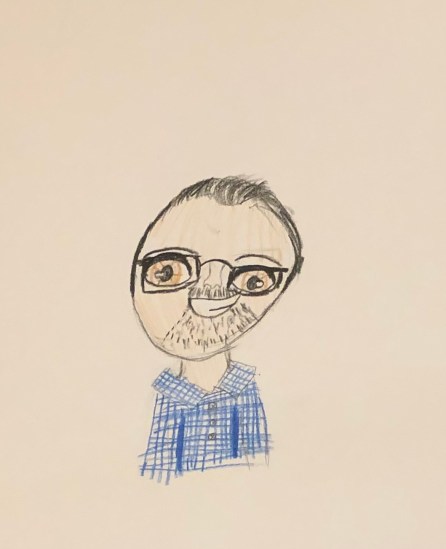
Six weeks ago, I launched my Draw the Author Contest to find a new author portrait for my upcoming series of Geeger the Robot early chapter books. The contest was only open for three weeks, but in that time, I received hundreds of submissions from kids all over the country (and a couple dozen from kids abroad, too!). Looking through the submissions was both delightful — there was so much talent on display! — and stressful — how was I going to choose just one of these amazing drawings?! I mean, I knew the decision was going to be tough. But I didn’t quite realize it was going to be this tough.

In the end, after poring over the submissions for several days, I decided that I, in fact, couldn’t pick just one drawing. But I figured I could pick, say, four drawings. And there just so happens to be FOUR books in the Geeger the Robot series. And so, my publisher and I decided to include a different portrait in each of the four books.

Now, without further ado, I present to you the winners of the Draw the Author Contest…

Appearing in Book 1 of the Geeger the Robot series will be this portrait by kindergartener Noah:

noah.jpeg

Appearing in Book 2 of the Geeger the Robot series will be this portrait by 3rd grader Annabelle:

annabelle.JPG

Appearing in Book 3 of the Geeger the Robot series will be this portrait by 6th grader Dominic:

dominic.jpg

And appearing in Book 4 of the Geeger the Robot series will be this portrait by 5th grader Ariah:

ariah.jpeg

THANK YOU to every kid who entered my contest, and THANK YOU to every adult who shared the contest with their students and/or kids. I am BEYOND excited to be able to feature these incredible kid creations in my books.

~ Jarrett

EngiNerds: the AUDIOBOOK!

audiobook.jpg

I’m super excited to share that the rights to the audiobook edition of EngiNerds were recently purchased by Tantor Media, and that the book is currently in production and scheduled for a June 16, 2020 release! Narrating the book will be James Fouhey! James received classical training at Boston University and the London Academy of Music and Dramatic Arts, and has gone on to record over 150 audiobooks. Once, James even voiced a rapping kid dinosaur — so, you know, he’s got some experience with off-the-wall characters. All of which is to say that, if there’s anyone I trust to voice my bottomlessly hungry, dangerously flatulent robots, it’s James.

~ Jarrett

Design a Medical Mask for a Healthcare Worker!

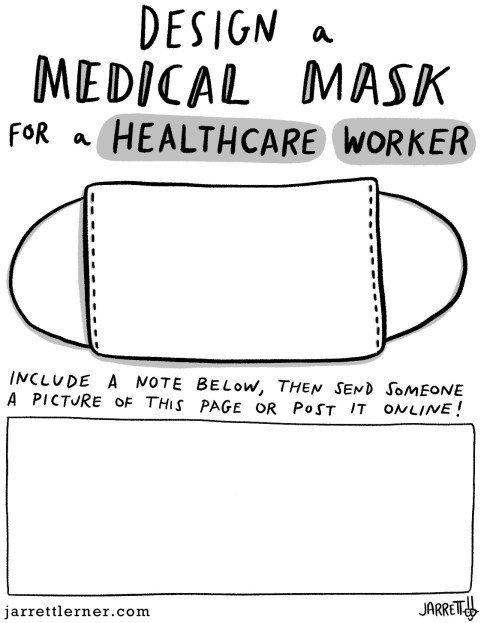
Last night, my friend and educator extraordinaire Rachel Harder suggested that I make an activity sheet prompting kids to design a medical mask for a healthcare worker. This morning, I whipped up the activity sheet below.

medical mask.jpg

Click HERE to download a printable version of the sheet. And as is true for ALL of my activities, I love seeing completed sheets, so please feel free to tag me if you post your or someone else’s work.

Also, for those without printers, the drawing above can be easily reproduced on any sheet of paper. The mask is just a rectangle flanked by a pair of semicircles, and you can leave room on the paper for a note if you wish to include one.

Thanks again for the great suggestion, Rachel!

~ Jarrett


KNIGHTS OF THE KIDS’ TABLE: Chapters 13 and 14

knights


Chapter 13


It took another hour, but the boys finally made it out of the Forest of Egergrel. After spending so long in that tree-covered darkness, the sun seemed cruelly bright. Standing at the forest’s edge, they squinted and groaned and even swatted at that distant star.

Kinsmere was the first to fully open his eyes. Looking around, he saw a large, flat field, much like the ones the boys had crossed to get to the Forest of Egergrel. But it couldn’t have been the same field, Kinsmere assured himself. He was mentally retracing their steps, trying to figure out if they could have taken a wrong turn somewhere, when he spotted another sign. From the back, it looked similar to the one that the boys had seen before: a wide, flat piece of wood nailed into another, taller and thinner piece of wood.

Grinning, feeling giddy, Kinsmere hurried around to the front of the sign. There he saw several painted symbols, just like he and his friends had seen on the other sign. There was the horse. The sword. The spear. The steaming kettle. The crooked stick. The dragon. The goblet. The shield. The hunk of smelly cheese and – Kinsmere’s heart picked up speed – an arrow.

The boy’s eyes leapt back and forth between the sign and the direction in which that arrow seemed to be pointing.

Slowly, his grin shriveled.

“Darn it!”

“What is it?” Gehry said.

“Another sign,” said Kinsmere. “It’s like the one before, and it’s telling us to go right back into this stupid forest.”

“Ah,” said Bruce. “Interesting. Say, you wouldn’t happen to mean the forest that belongs to the troll-giant you just crossed, would you?”

Kinsmere whirled around to face his friend. “Will you quit it already with the crossing the troll-giant stuff? We’ve got more important things to deal with right now.”

“Right,” Bruce said. “Such as the fact that we’re gonna have to go back in there” – he threw a hand toward the Forest of Egergrel – “if we want to find your oh-so-precious swords and spears. Because crossing a troll-giant isn’t enough for you, is it, Kin? And losing our horses and all our supplies? That’s not enough, either. No, no, no. We’ve also got to lose our lives. We’ve got to – ”

Stop it!” Kinsmere spat. “You’re just hungry,” he said. “You’re hungry and grouchy because you haven’t eaten in the past five minutes.”

Minutes?!” Bruce said. He tossed his head back and sent a bark of laughter up at the sky. “More like the past five hours. I haven’t eaten, and I probably never will eat again. Not if things keep going like this. I’ll be a troll-giant’s lunch before I get a bite of my own.”

Kinsmere smirked. “Let’s just hope you’re plump enough to satisfy the guy. Then maybe Gehry and I can get away.”

Bruce’s eyes popped open wide. His breathing grew heavy and erratic, and his nostrils flared like a teased and taunted bull’s. He let out a roar and charged Kinsmere, aiming to use his “plumpness” to tackle his “friend” to the ground.

But Bruce never made it over to Kinsmere. While still several feet away, he abruptly stopped, almost as if he had run into an invisible wall. Flinging his head back, the boy then began to turn and turn in small, tight circles, all the while gasping for air.

Bruce carried on like this for nearly a minute, at which point he came to another abrupt stop. Lowering his head, looking at his friends, he told them, “Cheese.”

Kinsmere, who had crouched down low in anticipation of Bruce’s attack, stood up straight. “Cheese?”

Gehry rushed to Bruce’s side. “Where, Bruce?” he said. “Where?

Bruce went back to spinning and gasping. He did so more slowly this time, and it only lasted a few seconds. He came to a stop with his back facing the Forest of Egergrel. Lifting his arm, he pointed to a spot straight ahead of him and said, “There.”

All three boys peered into the distance.

“Oh,” Gehry said. “You mean where that little castle-shaped thing is?”

It was small, a pebble perched on the horizon, but very clearly a castle.

“And hey,” Kinsmere said, aiming a finger at a spot off to the side of the distant structure.

There were three brown lumpy things standing in an especially lush portion of the field. The front halves of these four-legged lumps kept dipping down to the ground and yanking up hunks of grass.

“Well,” said Bruce, “at least our horses are getting some lunch.”

The boys set off, first to fetch their mounts and then to head to the castle.

It was a few minutes into the walk that Kinsmere said, “Someone should really fix those signs.”


Chapter 14


With every step the boys took, the scent of cheese grew stronger. After a while, the air was so thick with the odor that they could nearly taste the stuff.

“I’m pretty sure this is torture,” Bruce said shortly after they had reached and remounted their horses. “Is torture something knights-to-be are supposed to experience? Cause, yeah – I think we’ve got that part covered right here.”

A few minutes later – the castle was now the size of a radish, and the boys could see a flag flying from its tallest turret, white with a big orange dot in its center – pies began to fall out of the sky. The first few landed forty or so feet in front of the boys.

“Those aren’t . . . ” Gehry said. “Are they?”

“It looks like it,” Kinsmere said as another pie-like object splattered to the grass.

This one landed close enough to startle the horses. The animals planted their hooves and refused to go any farther.

Bruce, however, could not, and would not, be stopped. He tossed aside his reins and hurled himself out of his saddle. He crashed to the ground, belly-first, with an, “Oof,” but was on his feet a beat later, running toward the nearest pie. Once there, he bent down to investigate, which of course didn’t take long, Bruce being an expert in all things dessert. He sprang back up almost immediately and, arms thrown high and triumphant over his head, he did a happy dance.

“Pies!” he sang, “Pies, pies, pies!” as another, and then another, splatted down around him.

Once the miracle had been properly celebrated, Bruce dropped to his knees in front of one of the juiciest-looking pies. “It’s peach!” he called to his friends. “A peach pie! Heaven-sent!” He dug a hand down into the smashed-up pastry and scooped a flaky, goopy handful toward his mouth.

Wait!

This was Gehry, now hopping off his horse and rushing over to Bruce.

“How do we know it’s not poisoned?” he said. “Or enchanted? Or – or worse?”

Bruce blinked up at his friend. Then, very slowly, he finished bringing his hand to his mouth. He pushed the smooshed peaches and bits of piecrust past his lips and carefully chewed. Once he had swallowed the last of it, he sat there calmly, doing nothing. He was giving the poison a chance to kick in, the enchantment a moment to take hold of him. But nothing happened. And so Bruce scooped up a second handful and shoveled it down his throat.

Gehry and Kinsmere dug in, too, and for several minutes, the boys ate in silence. Or not exactly silence. There were plenty of sounds – moans and grunts of pleasure, the sucking of fingertips, the smacking of lips – just no words.

Until Kinsmere said, “Look at that.”

The other boys looked, and saw a pie flying high overhead. It sailed higher, and higher still, and hung there in the air so long it was as if it were considering becoming a star. When at last the pie came down, it was such a long ways away that, despite the quietness of the field, the boys couldn’t even hear it splat against the ground. They could, however, hear the boisterous cheers that rose up from the castle in the distance.

______

Text copyright © 2020 by Jarrett Lerner

All right reserved, including the right of reproduction in whole or in part in any form.

KNIGHTS OF THE KIDS’ TABLE: Chapters 10, 11, and 12

knights

PART II: The Forest of Egergrel


Chapter 10


The midday sunshine followed the boys into the forest, but didn’t stay long. Within a dozen steps, it seemed like evening, and after a dozen more, such little light snuck through the canopy of leaves and branches overhead that it might as well have been the middle of the night. If not for the rattling of their horses’ bridles, the boys might have each believed that his friends had been swallowed up by the darkness, that he was now making his way through the Forest of Egergrel alone.

It was Bruce who eventually asked, “Hey, are we still on that path?” He whispered the question, but not for any real reason. In that ink-black forest, whispering simply felt right.

I think so,” Gehry answered, whispering as well. “I mean, we must be. Right?

Right,” Kinsmere said. “If we weren’t, we’d be crashing into branches and trees and stuff.

They rode.

And rode and rode.

The forest seemed as endless as the fields the boys had crossed in order to reach it.

“Egergrel . . . ” Gehry said after a little while longer. This time, he didn’t whisper, but he still spoke softly, as if to himself. “Egergrel . . . ”

“What about him?” Kinsmere said.

“I’m pretty sure I was right,” Gehry answered.

“About what?”

“About his being a troll.”

“Oh yeah?” Kinsmere chuckled. “Lovely.”

“Gehry . . . ” It was Bruce, and there was more than a hint of worry in his voice. “Are you sure? Because if you are, then we should probably turn around.”

“Turn around?” Kinsmere said. “Nonsense. This is an adventure, Bruce. This is exactly what we’ve been looking for.”

“Okay,” Bruce said. “Right. Sure. But trolls, they’re – they’re fa-famous. Famous for being unfriendly to humans. And – and – ”

“Perfect,” Kinsmere said. And he meant it, too. The shine of his teeth, flashing through grinning lips, was just visible in the forest’s gloom. “That makes the whole thing even more adventurous.”

Bruce gave up. He knew he couldn’t convince Kinsmere to turn around. He doubted whether he could even persuade Gehry, who was now nudging his horse forward, urging the animal to go faster. He seemed eager, as dead-set as Kinsmere was on continuing through the forest. And if that was the case, Bruce figured he should conserve his energy. If they did run into a troll, he was going to need as much of it as he could get.

They rode.

And rode and rode and rode.

Time passed differently there in the forest. It was as if the darkness seeped into each second, turning it sluggish and extending the minutes into what felt like hours, like days.

But at last, the gloom began to ease. Some kind of brightness had leaked into the blackness. It wasn’t sunlight. Looking up, they could see that the crisscross of branches and leaves was tighter and thicker here, deep inside the Forest of Egergrel, than it had been anywhere else. Besides, the light was too orangey to be sunshine, and it kept flickering in a decidedly un-sunlight-like way.

“Fire,” Gehry said.

And as the boys steered their horses around the biggest, knobbiest tree that any one of them had ever seen, they saw that Gehry was right. There was a fire. A massive one. It was wider than the gates of the castle back home, and tossed up flames that reached as high as any of that structure’s towers or turrets. Behind the fire loomed a large, long-haired, wart-and-sore-covered lump of a creature. He was ugly, and dirty, and smelled like death.

“Well, Gehry?” Kinsmere said. “I don’t know if it’s a giant troll or a troll-giant, but it looks like you were right about that, too.”


Chapter 11


Once the horses got over the initial shock of encountering a creature such as Egergrel, they dumped their riders and darted off, quickly putting as much distance as possible between themselves and him.

The boys, however, stayed put.

Gehry was too fascinated to do anything else. His mind was racing so fast, he felt like he might fall over and start turning somersaults. He had read about troll-giants – who were different from regular trolls and regular giants, and different as well from giant trolls – and had even looked at drawings of them, but nothing could have prepared him for seeing one in the fetid, bug-ridden flesh.

Kinsmere stayed because this, at last, was it. Adventure. Also, of course, staying was the knightly thing to do. Fleeing in the face of danger was cowardly and dishonorable and, perhaps most importantly, an excellent recipe for long-term boredom.

Bruce, meanwhile, didn’t move because he had just been hurled to the ground by a spooked horse, and now he couldn’t seem to get his legs to work. Had he been able to, he would’ve been fleeing right behind the animals.

Not that it would have mattered much if Bruce – or any of the boys – had tried to run. Egergrel, in whose forest they were currently trespassing, had already spotted them, and running away from an angry troll-giant with six foot-long legs was no easy feat.

The troll-giant displayed the benefits of his size presently by leaping over his humongous fire toward the boys. He soared through the air and landed with an earth-shaking thud just a handful of feet away from them. Leaning down, then, and so low that the hairs on his wart- and sore-covered chin scraped the forest floor, the troll-giant roared at the boys:

“WHO DARE ENTER THE FOREST OF EGERGREL?”

The words were carried on a strong, sour-scented wind. And no number of years of being belched at back home could have possibly prepared the boys for such a scent. Imagine a hunk of meat that has been rotting for decades inside an old man’s favorite pair of boots. It was like that, only worse.

But the awful odor did do some good. It got Bruce’s legs working again. After a quick whiff, the boy was able to scramble to his feet. At which point he continued scrambling, first over to a nearby tree, and then behind it.

Kinsmere plugged his nose against the scent, but stood his ground.

Gehry did, too, and even managed to leave his hands hanging down at his sides. Kinsmere was inspired by what he believed to be his friend’s astounding display of bravery. In truth, however, Gehry simply understood that there was no use in trying to keep the horrid scent from slipping into his pores and wreaking havoc on his insides.

So he stood there, waiting to see if the smell would fade some – it didn’t – before answering the troll-giant’s question.

“I am Gehry,” he said, speaking slowly, loudly, and clearly, enunciating each word individually, as if it were its very own sentence. This was the way he had always imagined the knights in books spoke. Also, Gehry could see the grimy clumps of wax poking out of the troll-giant’s ears, and figured the creature might have some trouble hearing him if he did anything other than shout.

“GEHRY?” Egergrel roared. “WHAT KIND OF A SILLY NAME IS GEHRY?”

Clearing his throat, puffing his chest out in front of him, Gehry told the troll-giant, “The name was given to me by my father, Beribahn, King of the Realm and eldest son of Galaghand and Handelhar, who was daughter of Baghagelbisn, overseer of the Great Siege of Curnaffleflaffer and son to the one and only Todd, brother of Ferghelwergel, otherwise known as the Giant Slayer, and also sometimes Fungi Foot, who led the up – ”

It was there that Gehry stopped, having all of a sudden realized what he had just said. The thing about his great-great-granduncle, Ferghelwergel. Gehry didn’t know Egergrel all that well, but he had a feeling that the already-angry troll-giant wouldn’t be too impressed by the fact that he, Gehry, was related to a guy nicknamed “the Giant Slayer.”

The troll-giant, still crouched low to the forest floor, leaned in closer to Gehry. Now it wasn’t only the creature’s chin-hairs, but also his nose-hairs, that scraped the ground. Thick and stiff as broom handles, the hairs clawed at the dirt, raising up little puffs of dust that blew directly into Gehry’s face. The boy fought back the urge to cough. He stood completely still, preparing himself as best he could for the fury his words had no doubt provoked.

“IT’S NOT EGERGREL’S FAULT,” Egergrel howled at him. “EGERGREL CAN’T HELP IT.”

Gehry frowned, feeling baffled. He had never heard a troll-giant whine before, but it certainly sounded like this particular troll-giant was doing just that.

“DO YOU THINK EGERGREL WANTS TO BE LIKE THIS?” the creature continued. “DON’T YOU THINK IF EGERGREL COULD’VE DONE SOMETHING, EGERGREL WOULD’VE DONE IT ALREADY?”

The sadness and shame aroused in Egergrel by Gehry’s words literally stirred up the troll-giant’s insides. New smells wafted out alongside his cries. And with the scent of a sea’s worth of long-dead fish assaulting his nostrils, the smell of a hunk of rotten meat inside an old man’s almost-as-old boot seemed to Gehry like a pleasant memory. The boy couldn’t help but stagger back a ways from the troll-giant.

“YOU SHOULD MEET EGERGREL’S BROTHER,” the troll-giant went on. “HE’S WORSE THAN EGERGREL. EGERGREL ONCE SAW HIM SLAY A WHOLE PASTURE OF CATTLE JUST BY LIFTING UP HIS LEFT FOOT. AND THE RIGHT ONE’S EVEN WORSE. EGERGREL’S NOT THAT BAD. EGERGREL NEVER KILLED AN ANIMAL. NOT LIKE THAT.”

Now Gehry was more than just baffled. He was befuddled, bewildered, and even a tad flabbergasted, too. He was also still stuck on the idea that he had angered Egergrel by mentioning his giant-slaying relative.

“I never even met the guy,” he tried to explain. “And a lot of those nicknames? You know how it is. They get overblown so easily. I mean, he may not have ever even slayed a – ”

A hand – a human one, fortunately – clapped over Gehry’s mouth before he could finish.

Shhh.” It was Bruce, hissing in Gehry’s ear. The boy had crept out from behind his tree just in time. “Trolls, Gehry,” he said. “What are they famous for?”

Gehry had no clue where his friend was going with this, but he answered the question all the same. “For being unfriendly to humans,” he said.

Bruce shook his head. “What else, Gehry?”

“For being . . . well, for being really, really dumb.”

“Exactly.”

“You mean – ”

“Yes!”

“ – he thinks I called him ‘Fungi Foot?’”

Several feet away, out of earshot of his friends’ discussion, Kinsmere snapped his fingers. “Psst. You guys gonna tell me what’s going on, or what?”

Gehry smiled over at him, but turned back to Egergrel without telling Kinsmere a thing. Because he was clever, Kinsmere. Gehry knew he would catch on quickly enough.

“I think,” Gehry told the troll-giant, “that there’s been some sort of misunderstanding.”

Egergrel’s face drooped in confusion, and the sudden displacement of all that flesh caused a handful of warts to pop. Small gusts of warm, putrid air crashed across Gehry’s face, but the son of King Beribahn did not falter.

He said, “It seems you think I called you a mean name.”

“YOU DID!” Egergrel shouted. “YOU CALLED EGERGREL . . . YOU CALLED HIM . . . ” The troll-giant couldn’t even bear to repeat the hateful insult. He sniffled sadly, upsetting the leaves and twigs on the ground beneath his nose.

“No,” Gehry said. “Listen. You’ve got it all wrong. I wasn’t calling you that name.”

“YOU . . . YOU WEREN’T?”

Gehry laughed at the absurdity of such a thing. “Of course not,” he said.

“THEN WHY’D YOU SAY IT?”

“Well,” Gehry said. “Because I, ah – I was – errr – ”

“He was calling himself that!”

Kinsmere gave Gehry a wink as he strode over to stand beside him.

“See,” he went on, “back where we’re from, that’s what everybody calls him.” He stuck a finger out toward Gehry. “That and other, even meaner things.”

Egergrel sniffled again.

“But we came here,” Kinsmere said, slipping into the same bouncy tone of voice used by marketplace peddlers all across the Realm, “into the lovely Forest of Egergrel, for the sole purpose of giving you – Mr. Egergrel, sir – a piece of very big and exciting news.

“You see,” the boy said after a long, dramatic pause. “My friends and I – ” He tapped the brown, black-spotted wart on the tip of Egergrel’s nose with a fingertip. “ – we’ve found a cure.”

The troll-giant’s enormous eyes grew a little more enormous.

Are you insane?!” This was Bruce, who had crept over to Kinsmere to hiss in his ear. “What do you think you’re doing?!

“I think,” Kinsmere answered quietly, “that I’m saving us from becoming this guy’s lunch.” He shoved Bruce away, then turned back to Egergrel. “That’s right,” he said, sounding like a marketplace peddler again. “A cure. Now, Mr. Egergrel, I ask you – what do you say to that?”

The troll-giant’s face drooped lower as he mutterered to himself, carefully picking apart Kinsmere’s words.

Finally he said, “WHAT’S A CURE?”

“What’s the cure?” Kinsmere asked.

Egergrel shook his head. “WHAT’S A CURE?”

“Oh,” Kinsmere said. “Like, what’s the word mean?”

The troll-giant nodded.

“Well, it’s a way of getting rid of something,” Kinsmere explained. “A way to take something bad and make it better. Much, much better.”

It took Egergrel another minute to piece things together. At which point he said, “EGERGREL WOULD LIKE THIS.”

“Oh?” Kinsmere said, as if he hadn’t been expecting such a response. “If that’s the case, then we can go get it.” He hooked a thumb over his shoulder. “We don’t have it here, but we can go grab it and bring it back.”

“EGERGREL WOULD LIKE SOON.”

“Of course you would,” Kinsmere said. “And it won’t take us long. It’s not far. We can be back in a jiff.”

Egergrel examined each of the boys in turn – Kinsmere, then Gehry, then Bruce – as if deciding whether he could trust them. Should he pass up doing terrible things to a few defenseless humans in exchange for a cure that could forever rid him of the rancid collection of infestations that had been savaging his feet for decades? It was, for Egergrel, a difficult question. The troll-giant brought his nose down close to his feet, wiggled his toes, gave a quick sniff – and reared back in disgust.

“OKAY,” he said, standing up to his full, imposing height and aiming one of his massive fingers down at Kinsmere. “BUT SOON.”

“Of course,” the boy said. “Soon. Very soon.”

He took a step back. Then he took another. He waved at Gehry and Bruce to follow, and they did, moving slowly at first, but speeding up once they had made it past the big tree that had earlier blocked Egergrel and his fire from view.

It was only once the flickerings of that fire could no longer be seen that the boys felt safe enough to talk to one another. Bruce spoke first. There was something he had been wanting to say ever since they had left the troll-giant behind. And just before the boys were swallowed up by the forest’s gloom again, he turned to Kinsmere and said it. “You’re an idiot.”


Chapter 12


Finding one’s way out of the Forest of Egergrel was no simple task. Thanks to the darkness, the boys were as good as blind. Now and again, a sliver of light managed to squeeze through the leaves and branches overhead, but never enough to illuminate the path that had led the boys into the forest in the first place.

Gehry led the way, his hands held out in front of him to feel for trees. Kinsmere and Bruce were close behind him, arguing at great length about whether Kinsmere’s deception of the troll-giant had been a stroke of pure genius, or a blunder of epic proportions.

“Look, Bruce, are we, or are we not, at this moment being mashed up in the jaws of that thing back there?”

“It’s not a question of at this moment,” Bruce said. “It doesn’t matter what’s happening right now. What matters is what’s going to happen later.”

Nothing’s going to happen later.”

“And in the name of the Realm,” said Bruce, “how do you know that?”

“Because trolls are dumb,” Kinsmere said. “Outrageously, impossibly dumb. You said so yourself. And back there, Egergrel proved himself to be a particularly blockheaded specimen. He’s probably already forgotten about us, and that we ever even promised him a cure for his gross feet.”

Sighing, Bruce said, “I wish you would’ve paid a little more attention during lessons. Or, really, just any amount of attention at all.”

“Why’s that?”

“Because then you would’ve known not to cross a troll. And especially not a troll-giant.”

Now Kinsmere sighed. “I really don’t see what the big deal is,” he said.

Bruce shook his head. “Gehry!” he called up to his friend. “Besides being unfriendly to humans and being really, really dumb, what are trolls famous for?”

“Revenge,” Gehry promptly answered.

“Now you see?” Bruce asked Kinsmere.

“Whatever,” the boy said. “One day, when the stories of our adventures get written down for future generations, they’ll change all that. People will say, ‘It’s never wise to cross a troll – unless your name happens to be Kinsmere the Great! Crosser of Trolls and – ’”

There was a thud.

Kinsmere had walked into a tree.

Bruce forgot all about his Kinsmere-related frustrations and Egergrel-related fears. He erupted with laughter, and quoted Kinsmere back to himself as best as he could between bursts of hilarity.

“Did you just – you said – hold on, hold – Kinsmere the Great! Crosser of Trolls and – and – ”

There was another thud.

Bruce had walked into a tree.

“Ha!” Kinsmere shouted back at Bruce. “That’s what you get, you – you – ”

Guys.” Gehry cut Kinsmere off before the argument could turn into the usual battle of escalating insults. “How about we focus on getting out of this forest. Is that something the two of you can agree on?”

In a low, mopey singsong – like the voices of children who had been caught doing something they knew they shouldn’t have been doing – both Kinsmere and Bruce said, “Yes, Gehry.”

The boys pressed on.

______

Text copyright © 2020 by Jarrett Lerner

All right reserved, including the right of reproduction in whole or in part in any form.
Introduction to Hand-Lettering (Parts 1 & 2)

Since I began sharing more and more of my activity sheets a couple weeks ago, I’ve gotten hundreds of notes from kids and parents all over the world — from every continent, actually, except Antarctica (I guess penguins aren’t into making comics…). Most of these notes are to share finished activities and completed comics, all of which have been consistently blowing me away and making me very, very excited about all the books and graphic novels these kids are going to create someday, and that I’ll get to read!

Some of the notes also contained special requests — such as the one from the girl who said she desperately needed more cat comics to finish (I made another batch of them as quickly as I could!). Many of the notes included questions, too. Several of these questions were about the hand-lettering I do throughout the activity sheets. Kids wanted to know how I did it, and how they can learn to do it, too.

To satisfy these curious minds — and to hopefully get a whole bunch of kids hand-lettering like crazy! — I drew up a couple sheets of tips and techniques.

To download printable, sharable versions of these sheets, click HERE and HERE. I hope they are useful!

~ Jarrett

KNIGHTS OF THE KIDS’ TABLE: Chapters 7, 8, and 9

knights

Chapter 7


None of the boys got much sleep that night. Gehry and Kinsmere stayed up late together. First they practiced their swordsmanship (Kinsmere’s idea), then they packed their bags and made sure their horses had been well-fed (Gehry’s). Bruce, meanwhile, slumped about his bedroom, trying to think of a way to get out of joining his friends without heaping any more shame on his family. He couldn’t.

Morning came, and between them, the boys had slept a total of six hours. However, when they mounted their horses and strode through the castle gates, they didn’t look the least bit tired. There was too much excitement in the air – and, particularly in the air right around Bruce, too much terror – for that. Men and women, boys and girls, dogs and sheep and even a larger than normal contingent of flies had gathered on the lawn that stretched out before the castle, every one of them there to see off the Realm’s youngest knights-to-be.

Up on his horse, Gehry thought about his posture. He focused on his back and shoulders, on keeping the one stiff and the other straight. Now and again he looked down at the crowd on either side of him, but mostly he kept his chin tipped up and his eyes aimed forward, mimicking the posture of the knights he had read about in his favorite books.

Kinsmere was more relaxed. He waved and smiled and winked – and even blew a few kisses – at the damsels who, up until the previous evening, had ignored him completely. But this morning, they saw him in a new light. He was no longer a mere boy, but a boy on his way to becoming a man – to becoming a knight – and one that they might someday be lucky enough to marry.

Bruce brought up the rear, and refused to so much as glance at the crowd swelling around him. Doing so, he knew, would only increase his terror, and he had delayed his friends plenty already. It had taken Gehry and Kinsmere nearly twenty minutes to calm Bruce down enough to get him up on his horse. The animals could sense fear, and would toss a nervous rider before they took a single step with one on their back.

As soon as the boys had made it past the last of the onlookers, a cheer rose up from the crowd. People threw hats into the air. They threw shoes, then sticks and stones. One lady threw her baby up over her head. And once the belching began, a handful of especially enthusiastic well-wishers even threw up their breakfasts.

“Can you believe it?” Kinsmere said to his friends. “This time yesterday, we never would’ve believed that we’d be setting out like this. Not now. Not today. Probably not even a year from today.”

“But here we are,” Gehry said.

“Here we are,” Kinsmere agreed.

The boys waited. They were both hoping Bruce would echo the sentiment.

Bruce,” Kinsmere finally said. “We’re kind of trying to have a moment here.”

There was no answer.

“Bruce?”

Gehry and Kinsmere both looked behind them. They found their friend in a heap on the ground about forty feet back. The boy’s horse had dumped him, and was now trotting back toward the castle. A few of the braver men from the crowd of onlookers intercepted the animal before she could get all the way to the stables. They spent a couple minutes calming her down, then helped Gehry and Kinsmere get Bruce back up into his saddle.


Chapter 8


The boys rode for several hours without incident. They passed through one field after another. In some fields, the grass grew a bit taller than in others. Sometimes, the ground was soft. Other times, it was not-so-soft.

They rode.

And rode and rode and rode.

It was, in a word, boring.

Every few minutes, Kinsmere looked back over his shoulder. He did so in the hopes that Bruce had been tossed off his horse again, not out of any animosity toward his friend, but just so that the boys would have something to do to break up the monotony of the fields and the thumphthumphthumph of their horses’ hooves beneath them. Alas, Bruce seemed to have gotten his nerves under control. His horse clomped along, pulling up mouthfuls of grass whenever they passed a particularly tall patch. Clomping, chewing, she seemed content.

“So,” Bruce said after yet another, incident-less hour had passed. “Do the adventures just . . . come to us? Or is it more like a we find them sort of thing?”

His friends didn’t have an answer for him.

Eventually, however, Kinsmere said, “You know, for all the stories I’ve heard about knights and their adventures, I’ve never really understood that.”

“Me neither,” Gehry admitted.

Kinsmere chuckled. “Isn’t that weird? They always say, ‘He rode forth, and found adventure.’”

This last part the boy said in a deep, booming baritone, the kind of tone favored by the Realm’s most dramatic storytellers. The imitation was a good one, equal parts accurate and silly. It got Bruce giggling.

“They never say, ‘He followed the directions given to him by the other knights,’” Kinsmere said. “Or, ‘He rode north, as everyone knows you’re supposed to do.’”

“Yeah,” Gehry said. “But maybe that’s part of it. Maybe figuring out where the adventures are is the first, you know, obstacle.”

“Maybe,” Kinsmere said, but he didn’t sound convinced. “It just seems like a really slow way of doing things. Especially if what your dad said is true, and the Realm needs more men so badly.”

“Hey. About that,” said Bruce. “I was gonna say . . . ” He bit his lip, as if he wasn’t sure whether he should go on. “Doesn’t it seem just a little bit, well, foolish?”

Both Gehry and Kinsmere turned to face him.

“Foolish?” Gehry said.

“What is?” Kinsmere asked.

“Sending the three of us out here,” Bruce explained. “Making us the ones who are supposed to defend the Realm against all these rogue knights.”

Gehry frowned. But then, gradually, he began to nod. “I guess we are a little young.”

“But think about it,” Kinsmere said. “What other choice did they have? It’s basic arithmetic, really. Say the Realm’s got x number of men. They need to add to that number, right? But where do the men come from? It’s not like they can do anything with the men they’ve already got. So they send their non-men out to become men. They send us. And once we’re done out here? Once we get back? The Realm’s got x + 3 number of men.”

Satisfied with his little lesson, Kinsmere grinned. And Gehry – he was nodding again. After all, Kinsmere’s math was accurate, his logic sound.

Bruce, however, didn’t buy it.

“Not so fast,” he said. “Because as soon as you add some flesh and blood to that equation – especially my flesh and blood – it breaks down. I mean, the likelihood of a few kids surviving out on the fringes of the Realm, all on their own, jousting and sword-fighting and whatever else-ing with men two or three times their size?”

“Wha – ” Kinsmere began.

But Bruce started up again before he could get any further. “And say, on top of all that, they – these kids – say they run into some even worse characters. You know, witches and ogres and demons and stuff. Say they’ve got to try and fend off spells and enchantments and all sorts of big, strong, dark, scary forces. Say they’ve got to go up against that.”

His grin long gone, Kinsmere swallowed hard. “Say they do,” he said. “Say they do.”

Bruce shrugged and said, “It’s just not very likely, that’s all. I mean, nothing against your dad, Gehry, but like I said, it just doesn’t seem all that thought out.” He bit his lip again, but only briefly. “If I’m being totally honest, it actually seems kinda . . . ”

Kinsmere said, “Kinda what?”

“Well,” said Bruce. “Kinda dumb.”

Neither Gehry nor Kinsmere had anything to say to this. They didn’t seem angry, though. Deeply confused? Yes. But not angry. And so Bruce kept talking.

“And since we’re on the subject?” he said, his voice higher than normal, as if it were proceeding carefully, on its tiptoes. “Isn’t the whole entire thing kind of dumb?”

“What whole entire thing?” Gehry said.

Here, Bruce came close to telling his friends never mind, to changing the subject, maybe saying something about how this flat expanse of grass was so much prettier than that other flat expanse of grass they had just rode across. But he couldn’t do it. He had lived alone with these thoughts for far too long. And every day, it seemed, they took up more space in his brain. They grew bigger, and stronger, and fought harder to be heard. Just now, Bruce could feel them climbing up his throat, throbbing on the tip of his tongue.

So he said it.

He said: “Knighthood.”

Bruce’s horse bucked. It was as if she had understood what the boy on her back had said, and as if she simply refused to carry such a traitorous idiot for another instant.

Somehow, Bruce held on. He clung to his saddle until the irate horse calmed down. Looking up, he found his friends staring at him. Their horses, too. Four pairs of eyes, big and blinking, waiting for some kind of explanation.

“Hold on,” Bruce said. “Just listen.”

“Holding,” said Kinsmere.

“Listening,” said Gehry.

“It’s just – ” Bruce paused to let out a long, heavy sigh. It had been in him, that sigh, building and building, for months, maybe even years. “I guess I just never understood how it all added up. Like, you go out and find a random guy who happens to not be as big a fan of the Realm as you are. You find him, and you don’t even bother talking to him first. You don’t get to know him at all. You don’t hear him out and then maybe help him see, maybe get him to a point where he’s like, okay, yeah, maybe the Realm’s not so bad after all. Nuh-uh. You just whip out your sword and fight the guy until one of you is dead. And, I mean, if the Realm really needs more men, then why not try and get some of these rogue knights to just stop being so rogue? You know? Talk about arithmetic. Every guy you got to renounce his rogue-ness would actually be worth two guys. You’d have one less enemy, and one more friend. I mean, I don’t know. It’s just – it’s always seemed to me like no one’s ever sat down and thought this whole thing through.”

If you’ve ever scarfed down a bowl of chilled pudding immediately after it has been brought up from the depths of a cool cellar, then you’ll know how Bruce’s words left Gehry and Kinsmere feeling. It was as if their brains had been replaced by blocks of ice. They couldn’t think. Their skulls pulsed with a cold, dull pain.

If not for the boys’ horses, they might have gone on sitting there forever. But after a moment, Gehry’s horse started off again across the flat expanse of grass before them. Bruce’s and Kinsmere’s animals were quick to follow.

Fifteen minutes passed before another word was spoken. That word was, “Hey,” and it was Gehry, still riding at the front of the pack, who spoke it. “I think . . . I think we found it.”

“Found what?” Kinsmere said.

“Adventure,” Gehry told him.

Kinsmere and Bruce nudged their horses forward and fell into step on either side of their friend. They looked ahead, to where Gehry was pointing, and saw a sign – a wide, flat piece of wood that had been nailed to another, taller and thinner piece of wood. Several symbols had been painted onto the sign. There was a horse. A sword. A spear. A steaming kettle. A crooked stick. A dragon. A goblet. A shield. And also, in the lower corner, what appeared to be a hunk of smelly cheese.


Chapter 9


It was hard to tell for sure, but based on its positioning, the sign seemed to be pointing the boys toward a small patch of trees in the distance. They set out in that direction, and soon found a path. It was faint, nothing but a thin band of grass that had been trampled a bit more than the rest of the field around it. But it was clear enough that dozens, if not hundreds, of other pairs of feet had previously traveled that very same route.

It took the boys half an hour to reach those trees. Which, as it turned out, weren’t so much a small patch as they were the start of a large, gradually widening forest – the Forest of Egergrel. This was according to another sign, a thin strip of painted-upon wood that had been nailed to the trunk of a tree.

“Who’s Egergrel?” Bruce asked.

“If you haven’t heard of him,” Kinsmere said, “then I definitely haven’t. You actually paid attention during lessons.” He turned to Gehry. “What about you, bookworm? You know who he is?”

Gehry gazed into the woods. “I think he’s a giant. Or no – a troll.”

Kinsmere smiled. “Or maybe a giant troll,” he said.

Or,” Gehry added, “a troll-giant.”

He wasn’t trying to be funny, but Kinsmere found this humorous enough to laugh.

Bruce said, “Let’s hope he’s none of the above. Let’s hope Egergrel’s just a nice old nonthreatening man whose hobbies include providing food and shelter to weary young travelers.”

A low, soul-shaking growl rose up from somewhere deep in the woods.

The boys’ horses all skittered backwards, away from the trees. Kinsmere’s even reared up onto her hind legs. Shrieking, the creature’s forelegs churned the air, swiping and slashing as if fending off an invisible beast. It was several seconds before Kinsmere managed to calm the horse down. The incident left the boy’s face, open and laughing a moment before, stricken and pale.

“Don’t worry,” Gehry told his friends. He urged his own horse forward, toward the trees. “That . . . ” he said. “That was just a – a bird.”

It was no bird. Gehry knew it, and so did Kinsmere and Bruce. Gehry also knew that Kinsmere and Bruce knew, and Kinsmere and Bruce even knew that Gehry knew they knew. But the lie gave the boys the courage to press on. It kept them from turning back or going around. It got them plunging forward into the dark, forbidding heart of the Forest of Egergrel.

______

Text copyright © 2020 by Jarrett Lerner

All right reserved, including the right of reproduction in whole or in part in any form.

KNIGHTS OF THE KIDS’ TABLE: Chapters 4, 5, and 6

knights


Chapter 4


Bruce had a Top Ten List. Top ten feasts, that is. Rankings were made using a system that Bruce had devised himself. First, each feast was rigorously analyzed based on a number of factors, including the variety of selection, the size of the portions, the availability of seconds, the type and quality of entertainment, and the mood and behavior of the servers and guests. Once a decision was reached regarding the greatness of a particular feast, it was compared to all the other great feasts that Bruce had been lucky enough to attend. And though it sometimes took him days of agonizing decision-making, sooner or later Bruce always slotted a new list-worthy feast into his rankings, waving a bittersweet goodbye to the not-quite-as-great – but still pretty darn excellent – meal that had previously occupied the Number 10 spot.

It was within two seconds of stepping into the dining hall that evening that Bruce realized he was looking at his new Number 1. Because this feast – it was spectacular. He stopped just past the doorway and stared in astonishment at the tables upon tables overflowing with food.

There were platters piled high with every kind of meat imaginable, plus what appeared to be three of four whole farms’ worth of vegetables. There was cheese galore, enough loaves of bread to fortify a village, and countless cakes covered in spices and seeds and doused in delicious, sticky syrups. Bruce wouldn’t let himself get too good a look the cakes, though, fearing he might faint and not get to enjoy a single bite of anything.

Gehry and Kinsmere were equally stunned by the extravagance of the feast. But there was a hint of nervousness to their expressions as well. It was as if the boys could somehow sense the momentous purpose behind the gathering.

Kinsmere was the first of the boys to find his voice. “I guess we should . . . eat,” he said.

Once they had each piled their plates with some of everything, the boys crossed the hall to the far corner, to the so-called kids’ table. That was where the sons of knights – the knights-to-be – sat. At some point, every knight-to-be was sent off from the castle in search of adventure. If, during his travels, the boy performed great deeds and behaved valiantly, he would be properly knighted upon his return, and could then move his seat twenty feet to the side and eat his meals along with all the other adults.

But for Gehry and Kinsmere and Bruce, that day was a long ways away. The boys were many years younger than all the previous knights-to-be had been when they had embarked on their first adventures. For now all the boys had to worry about was showing up to their lessons and attending feasts – a pair of tasks that Bruce, for one, found plenty fulfilling.

Hey.” It was Kinsmere, who had glanced at Bruce just as the boy was preparing his first forkful – a carefully crafted, delicately balanced tower of beef, broccoli, and brown, grain-busy bread.

“What?” Bruce asked.

“You know what,” Kinsmere said. “A knight’s not supposed to start eating before the king’s delivered his address.”

“That’s true,” said Bruce. “And since I just so happen to not be a knight . . . ” He brought his attention back to his fork.
But Kinsmere wouldn’t leave him be. He reached across the table and snatched the fork right out of Bruce’s hands, the beef and bread and broccoli dropping, untasted, to the floor.

“You’ve got a long way to go if you ever want to be a knight,” Kinsmere said. “No harm in getting a head-start.”

Bruce glared at his friend. “I could say the same to you. You – you – you fork-snatcher.”

Kinsmere laughed.

“What’s so funny?” Bruce said. “If it’s un-knightly to have a bite to eat before the king’s given his address, then stealing another knight’s fork has got to be un-knightly, too.”

“Lucky for me,” Kinsmere said with a grin, “you just so happen not to be a knight.”

Bruce’s face twisted up with frustration and fury. “Give it back,” he demanded.

Kinsmere gave a single shake of his head.

“Give it.”

“No way, ogre-nose.”

Bruce pounded a fist down onto the table. Then, keeping his eyes locked on Kinsmere – if he didn’t, he knew he might lose his plate, too – he appealed to Gehry. “Gehry,” he said. “Make him give me my fork back.”

Bruce got no answer, and so he tried again. “Gehry,” he whined. “Gehry, please.”

Again Bruce got no answer, and this time, desperate, he turned to face his friend, risking the loss of the lemon poppy seed cake that he knew for a fact was one of Kinsmere’s favorites. “Geh – ” he began. But he made it no further. He went quiet as soon as he saw the strange, blank look on his friend’s face.

“Gehry?” he said.

Kinsmere, hand poised over Bruce’s lemon poppy seed cake, froze when he heard the sudden shift in the boy’s voice. It had gone from sounding whiny to sounding concerned, even scared. He looked across the table at Bruce, then turned toward Gehry.

“Hey,” he said. “Gehry. What are you looking at?”

It took the boy a moment to answer. And when he finally did, he spoke too softly to be heard. He barely even moved his lips.

“Huh?” Bruce said as he and Kinsmere began to look around the hall.

At that point, however, there was no need for Gehry to repeat himself. Because no matter where the boys looked – at the king and queen up front in the seats of honor, at the adults along the hall’s other couple dozen tables, even over at the servers stationed near the heaps of food – every pair of eyes stared right back at them.


Chapter 5


The feast-bell clanged, and clanged, and clanged again. By the end of the third clang, every knight, lady, damsel, and dog in the dining hall had made it to their seat.

And as soon as his guests had quieted down, King Beribahn got to his feet. He was a tall man, and strong even in his older years. His beard had gone gray around the mouth, but otherwise his hair was as dark and red as it had been in his adventuring days. Back then, rogues of every kind spoke in frightened tones of the “flame-headed knight.” If he came knocking at your door, they would say, you knew your days of lawlessness were through.

The king reached for his cup, raised it high above his head, and shouted, “To the Realm!” After which he attempted to drink his wine as fast as humanly possible. In the Realm, this was a nearly sacred tradition, and though a fair amount of the purplish liquid ended up dripping into the king’s beard and onto his shirt, no one batted an eye. Spilling all over oneself had always been an important part of the tradition, too.

Having guzzled and spilled expertly, King Beribahn set his empty cup back down on the table. There was a smattering of applause, which the king patiently endured. Only once he had complete and utter silence did he throw his arms out to his sides and let loose a king-sized belch. It caused the crowd to leap to their feet. They cheered madly, and everyone who was able to sent belches of their own wafting back at their beloved ruler.

The king watched all this with a big, bright smile. But shortly after his gassy subjects had settled back down into their seats, that brightness vanished. The king’s expression turned solemn and dark. He strode back and forth across the front of the hall, his eyes aimed down at the toes of his boots.

“Friends of the Realm,” he said at last, glancing out at the crowd but continuing his pacing. “I address you this evening as your king – Beribahn, eldest son of Galaghand and Handelhar, who was daughter of Baghagelbisn, overseer of the Great Siege of Curnaffleflaffer and son to the one and only Todd, brother of Ferghelwergel, otherwise known as the Giant Slayer, and also sometimes Fungi Foot, who led the uprising at Yarlamik, and once met Penlaghel, also known as the Crazed King, at a party.”

The king paused by his seat to have a drink of water. Then he got back to pacing, and back to speaking, too.

“Many of you – no, no – I dare say most of you know the reason why I’ve called this feast.”

Gehry, Kinsmere, and Bruce peered around the hall. Every head was nodding. It was clear that the boys were the only ones in the place who had no clue what was going on.

“The Realm,” the king said, “has seen happier days than these. Days when the few foes we had were cowardly, weak, and easily done away with, if not simply ignored. Those times, I am sad to say, have passed. We have lately seen a surge in violence, in brutal, treacherous acts committed by rogue knights who have established themselves along the fringes of the Realm.

“It is therefore more important than ever for us to remain strong and true, and to reinforce the ties that bind us to one another and to the Realm at large. For it is not just our lives, but our way of life – our culture and beliefs, our values, our understanding of right and wrong and good and evil – that is at risk.

“These past few months, we have been more vigilant and vigorous than ever, not merely defending ourselves from active threats but venturing forth to prevent such threats from materializing in the first place. We have had many successes. Great deeds have been done, and glorious adventures have been had.

“I remind you of this so that I can thank you, every single one of you, for your service to the Realm. For whether or not you’re one of those who has ridden out from the castle, I assure you, you have played a part in defending the Realm. Without the help of each of you, of all of you, we would not be – and could not in the future remain – who we are today.

“But I have gathered you here for another reason, as well. I have gathered you, friends, in order to make an announcement. An historic announcement, no doubt, and one that – for reasons both personal and professional – deserves a celebration unmatched in the great and glorious annals of the Realm.”

The king paused for another sip of water. This time, however, he didn’t immediately return to his speech. He held onto the cup, and gazed down into its depths with a dreamy, faraway look in his eyes. Around him, the hall was silent. You could hear the rumbling of empty stomachs, the hopping of fleas on the backs of the dogs. And the air – it felt as taut as a harp string. Move a muscle, or even think too hard about moving one, and you would make it sing.

“We need more men,” the king said at last. He set his cup down firmly and turned to face the crowd, his expression once again solemn and dark. “That’s what this all comes down to. We need more men. I can say it no simpler than that. But a simple thing it is not. To become a man, a knight both brave and true, is no easy task. It can take years. It can take a lifetime’s worth of grueling effort. It is a labor of love – of love, first and foremost, for the Realm – but it would be foolish to assume that it is therefore a purely joyous and pleasant experience. It is not. But we need them. More men. We need them desperately.

“All of which is to say that I, King Beribahn, with my fellow knights among me, have decided to break precedent in these unprecedented times, and send forth – ” The king had to pause to clear something from his throat. “ – and send forth our youngest, dearest, our most-cherished boys, our knights-to-be, to seek adventure and overcome whatever obstacles they may encounter, and to one day return to this castle worthy of being knighted, of sitting here among us as those same brave defenders of the Realm that we so desperately need.”

Chairs scraped back against the floor as every guest – except, of course, for the boys – jumped to their feet. The crowd cheered and hollered and roared, then reached for their cups and guzzled their contents as quickly as they could. Men drenched their beards and soaked their shirts, ladies stained their dresses and ruined their jewelry, and all of this in the name of honoring Gehry, Kinsmere, and Bruce. Thoroughly soiled, the adults turned to the boys and conveyed their love and appreciation along with their belches and burps.

It wasn’t long after this that the king threw his royal cup up into the air. The cup was made of fire-hardened clay, and had been intricately and exquisitely decorated by one of the Realm’s finest artisans. Throwing it, the king made sure it soared high. It hung there a moment, frozen beneath a heavy wooden ceiling beam. Then the cup came tumbling down. The instant it hit the floor and burst into pieces, the band in the corner broke into song. Somewhere, an artisan wept. But the feast had officially begun.

Over at the kids’ table, the boys sat in silence. Not one of them had been expecting the king’s announcement, of course. But their reactions to the news couldn’t have been more different.

Kinsmere was thrilled. Grinning, baring every one of his teeth, his cheeks were as red as a pair of raspberry-rubbed rubies.

Gehry was solemn. His expression, in fact, wasn’t all that unlike the one his father had worn while delivering his address. The boy’s heart beat rapidly, but inside, he felt cool and supremely focused. It was how he felt sometimes during his lessons, if he was asked to recite a particularly long passage or answer a complicated question.

Bruce, meanwhile, was panicking. He scanned the hall frantically, his eyes bouncing from face to face, desperate to find the one that would assure him this was all an elaborate gag, a joke of King Beribahn’s.

There was, however, no one to do so.

Kinsmere reached across the table and set Bruce’s fork down beside his plate. “Eat up,” he told his friend. “This’ll probably be your last feast for a long time.”

Bruce looked down at the plate he had so ambitiously heaped with meats and veggies and cheeses and breads. He looked at that delicious lemon poppy seed cake, at its creamy, yellow, black-freckled skin. But for the first time in his life, Bruce didn’t feel the least bit hungry.


Chapter 6


King Beribahn let his guests eat, drink, and belch in each other’s faces for a full hour, at which point he rose to make another announcement. This one was brief. It was merely to inform the boys that it was time to confer with their fathers, something that all knights-to-be did the night before setting out on their quests. And so the boys abandoned the kids’ table, each of them heading off in a different direction.

Gehry, of course, headed for the front of the hall. On his way, several guests clapped him on the back or stuck a hand out for a shake. One very old man even grabbed Gehry by the shoulders and, leaning in close, said he knew that one day the boy would make a king as great as his father, and then belched repeatedly in Gehry’s face. And though Gehry knew that this should have been among the proudest moments of his life, the old man’s words and burps barely moved him. The boy remained solemn and serious. He still felt focused – though on what, exactly, he wasn’t sure.

He continued toward his parents, pausing finally a few feet in front of their seats. There, just as he had learned to do in his lessons, Gehry bowed low to the ground. He remained in the bent position for several seconds, and when he looked back up, the queen waved him forward.

Gehry went, but he didn’t greet his mother with a hug, as he would have done that morning, or even just an hour before. Instead he took the queen’s fingers lightly in his own and placed a gentle kiss atop her knuckles. It was as if the boy were a knight already.

The boy’s show of manners pleased the king. He beamed at Gehry, his one and only child, smiling wide enough for the whole hall to see the tooth he had lost years ago, as a young man, while wrestling Urgurgle the Ogre. (The ogre had also lost a tooth, in addition to his life.)

“There’s not much we have to say to you,” King Beribahn told Gehry. “We know you’ll do well out there. We know you’ll make us, and the Realm itself, as proud as we could ever hope to be.”

Gehry bowed again, dipping even lower than last time and holding the pose for an extra couple seconds.

Nearby, Kinsmere had just reached Sir Colton’s seat. For a full minute, no words passed between father and son. Sir Colton simply studied Kinsmere. He narrowed his eyes and moved them methodically over the boy’s face, back and forth and up and down as if looking there for something he had lost long ago.

Finally Sir Colton said, “If you’re half the man I was at your age, you’ll be fine.” He reached for his cup. He drank long and slow, his eyes searching his son’s face once more from over the rim. “Don’t be cocky,” he continued, returning the cup to the table. “Don’t be foolish. And don’t do anything to make me regret agreeing to send you out there in the first place.”

“Yes, sir,” Kinsmere said. “I aim to make you proud, sir.”

Sir Colton gave his son a curt nod and, without another word, turned back to the knights and ladies seated at his table. He laughed at a joke someone had just finished telling. Apparently, the father-son conference was over already.

Kinsmere headed back to the kids’ table. On the way, he passed by Bruce, who was still looking for his own father.

“How was it?” Bruce asked him.

“Good,” Kinsmere said. He smiled, too. “Great, actually. Really, really . . . great.”

Bruce was too anxious to notice how unconvincing his friend sounded, too distracted to see how fake the boy’s smile was. He gave Kinsmere a nod, then scanned the crowd again for his father. Spotting him, he said, “Well, wish me luck.”

Kinsmere did. “You’ll do fine,” he said, and patted Bruce on the back as the boy took off.

For that, Bruce was grateful. But the small burst of confidence given to him by his friend faded within a few steps. Bruce began to sweat, and sweat how he always did, which was profusely. His forehead and armpits, his back and thighs and knees and chest and feet – his entire body, essentially, went from being bone dry to sopping wet in a matter of seconds.

Sir Brent sighed when he saw his son. “I already spoke to your mother,” he told Bruce. “She knows not to expect you home again.”

“Not to – to – ” Bruce stammered.

Please,” Sir Brent hissed. “There’s no need to make a scene. You and I both know you won’t make it more than a fortnight out there. And that’s if you’re smart, and let your friends do the heavy lifting.”

“Yes, sir. I – ”

“And I mean that both figuratively and literally. Don’t try and carry anything too heavy. Let your friends do it, or put your things on your horse and walk alongside her. You hurt your back and you’re done for. A rogue knight’ll smell you from a mile away, and pick you off faster than you can say ‘cake.’”

“Yes, sir. I – of course I – ”

“Now go wipe yourself down,” Sir Brent said, turning from his son. “People are starting to stare.”

“Yes, sir,” Bruce said. “Sorry, sir. I . . . sorry.”

With that, he went. He returned to the kids’ table, where Gehry and Kinsmere were waiting for him. Neither of them asked Bruce how the conference had gone. They didn’t need to. The pain and shame were plainly visible on the boy’s face.

______

Text copyright © 2020 by Jarrett Lerner

All right reserved, including the right of reproduction in whole or in part in any form.
KNIGHTS OF THE KIDS’ TABLE: Chapters 1, 2, and 3

knights

PART I: A Feast to End All Feasts


Chapter 1


The boys were bored.

From the grassy slope atop which they sat, they had a clear view of the nearby castle. That was where the boys were looking, and each of them looked for reasons of his own.

Gehry’s eyes were aimed at the castle’s upper corner, where the library was located. But the castle’s library was no ordinary sort of book-having place. The high-ceilinged room held the largest collection of books, manuscripts, and important papers in all of the Realm.

If only I could go in there, Gehry thought. I could pluck any book off the shelf, and sit there all day and read and read and read . . .

Kinsmere sat next to Gehry, and he had his sights trained on the castle’s lower floor – on the windows, to be precise, behind which the Realm’s youngest knights took up dulled swords and practiced their combat. It happened to be a quiet, breezy day, and even from way up at the top of the slope, the gorgeous sounds leaping out of that room could now and again be heard. There were the slices and clanks of blades striking blades, plus the rattle and clatter of armor being put on and taken off, then put on again for another round of mock combat.

If only I could go in there, Kinsmere thought. I could show them a thing or two about swordsmanship . . .

Bruce, the last of the trio, sat beside Kinsmere, and his gaze was fixed on a row of small holes at the very bottom of the castle’s outer wall. Most people would never – and had never – noticed these tiny apertures. But Bruce had long ago learned that the little, dinner roll-sized gaps led directly into the kitchen. They were vents, those holes, there to let out heat and steam so the cooks and servers didn’t faint away while preparing a feast. But the vents also let out smells. Magnificent, mouthwatering smells. The best smells in all the Realm. Smells of fried meat and boiled vegetables, of spiced cakes and seeded bread and, occasionally, a new dish, too, a strange, recently discovered flavor or combination of tastes that the chefs – not to mention a hungry boy for whom the castle’s kitchen was off limits – had never before dreamed of. Bruce opened his nostrils wide and tried to catch a whiff.

If only I could go in there, he thought. I could eat and eat and eat until my stomach burst . . .

A breeze blew by.

Bruce opened his nostrils even more.

Kinsmere turned his head to try and hear those slices and rattles and clanks.

And Gehry closed his eyes. He called to mind a passage from the book the boys had studied during their last lesson. It was the tale of a famous knight-to-be. Remembering the words, turning them over in his head, Gehry swapped the young man out for himself. And there he was – Gehry, seated atop a magnificent horse, the animal’s coat the pure, perfect white of a field of fresh snow. They rode hard, him and the horse, the wind whipping up off the land and crashing across Gehry’s face as he galloped away from the castle, out into the further reaches of the Realm, to find his very first adventure.


Chapter 2


I know,” Kinsmere said.

Gehry and Bruce both looked over. They watched their friend pluck a small stone from the ground. Rubbing the dirt off its ragged surface, Kinsmere tossed the stone into the air. He let it drift and hang for a moment, then snatched it up again.

“Let’s see who can hit the tree,” he said, pointing to the lone oak that sat on the opposite side of the slope-top. “Bet you I can do it three in a row.”

Gehry got to his feet.

Bruce stayed seated. “Thanks but no thanks,” he said. “Think I’ll just sit.”

“Of course you will,” Kinsmere said.

Bruce frowned. “What’s that supposed to mean?”

“It means,” Kinsmere said, “that you know you don’t have a shot against me, so there’s no use even trying.”

Bruce considered this. He knew what Kinsmere was doing, that he was only teasing him in order to try and lure him into playing the game. And Bruce knew, too, that as a knight-to-be, he was not supposed to turn down any kind of challenge, nor let any insult to his character go unanswered.

But he was so comfortable, sitting there with his backside planted in the soft, sun-warmed grass. Besides, he was hungry. And while he was handling his hunger well enough sitting down, if he stood up and started throwing stones and getting all sweaty? Well, that would surely get his stomach roaring and growling.

So Bruce shrugged his shoulders and, shimmying to one side, planted his backside a bit more firmly in the grass.

Gehry, meanwhile, had already gathered an armload of good-sized throwing stones. He carried them over to where Kinsmere was standing and piled them at his friend’s feet.

“I guess I’ll let you go first,” Kinsmere said, tossing his stone up and snatching it out of the air again.

Gehry took his time picking a stone from the pile. Once he had found the perfect one, he spent a moment bouncing it around in his hand. He rubbed his thumb over the stone’s smooth parts, flicked a fingernail on its rough edges. Finally, squeezing it hard against his palm, he reached back and sent the thing flying.

The stone sailed straight, and struck the tree in the very center of its trunk.

“Ha!”

This wasn’t the sound of Gehry celebrating. It was Bruce. He threw his head back and laughed up at the sky.

When he looked back down, he found Kinsmere glaring at him. Bruce flinched, thinking his friend might throw a stone at him.

Instead Kinsmere spun around and, without more than half a second’s preparation, hurled his stone into the distance. It was a good throw, and though it didn’t hit the very center of the tree’s trunk, it came close.

“One to one,” Kinsmere said.

Gehry went next, and nailed the tree.

Kinsmere did, too.

But on their third turns, both boys missed their target. Which meant, of course, that the contest started over again.

It dragged on like this for some time. One of the boys might hit the tree twice in a row, but never three. They were constantly starting over, and several times had to run over to the tree to fetch their stones.

All the while, Bruce stayed put and kept quiet. But as his friends were coming back from gathering their stones for a fifth time, he said, “You think something’s wrong over there?”

“Over where?” asked Gehry.

“The castle,” Bruce said.

Gehry and Kinsmere both turned toward the castle. It looked fine. The same as ever.

So Kinsmere said, “No.”

Gehry asked, “Why?”

“It just seems . . . ” said Bruce. “Well, shouldn’t they have called the feast by now?”

Gehry chuckled.

Kinsmere shook his head. “Is all you ever think about feasts and feasting?”

Bruce considered the question seriously. At last he said, “No. I also think about naps. Naps I like almost as much as feasting.”

Gehry laughed harder.

Kinsmere said, “With an attitude like that, you’ll never become a knight.” He shook his head again. “Think about how fun that would be. Bruce Richards, ninety-year-old knight-to-be.”

Bruce thought about what such a life would be like. He imagined a single day as a ninety-year-old knight-to-be. He would wake up, make his way to the dining hall, and have himself a nice, long, leisurely breakfast. Then, seeing as he would be exhausted from all that eating, he would go back to bed. He would get up from his post-breakfast nap in time for lunch, of course, after which he would go out to the slope to sit a bit, and maybe snooze, before dinner.

These thoughts brought a dreamy smile to Bruce’s lips. “Sounds lovely,” he said.

Kinsmere whirled around and chucked a stone. He watched it smack the trunk of the tree before turning back to Bruce. “Sounds terrible.”

Gehry threw, and hit the tree, too.

Kinsmere nodded, acknowledging the nice toss. Then he wound up, threw, and knocked the tree so hard he broke off a chuck of bark. It landed in the grass several feet away, and left a bare, whitish-brown spot on the trunk.

“Whoa,” Gehry said. “Good one.”

Kinsmere accepted the compliment with a little bow. “That’s two for me,” he said.

Gehry threw, but his stone went wide.

Kinsmere grinned. He picked a stone from the pile at his feet and then tossed it up a few times, getting a feel for its weight and shape.

“Prepared to lose?” he asked Gehry.

Gehry grinned back at his friend. “First,” he said, “you’ve got to win.”

Behind them, Bruce clapped and laughed. He was enjoying himself immensely.

All of a sudden, as if he had been whacked by the wand of a wizard, Kinsmere’s grin disappeared. It was replaced by a look of fierce determination. He narrowed his eyes and glared at his target as he rolled the stone around in his fingers, searching for the perfect grip. He found it at last, and pulling his arm back – was startled by the ringing of the feast-bell.

The stone flew high and wide. It missed the tree by a dozen feet in either direction.

Bruce laughed so hard he toppled backwards and rolled several feet down the slope.

Kinsmere hurried after him, and crouching down low, shoved his friend a few feet further.

“Stop it!” he shouted at Bruce. “That one doesn’t count!”

But Bruce couldn’t have kept the laughter from coming had he tried. Which he didn’t.

Gehry came down the slope after his friends. When he reached Kinsmere, he clapped him on the shoulder. “Don’t worry,” he told him. “We’ll play again tomorrow. And anyway, you had the nicest throw. That one that tore the bark off the tree? Amazing. Never seen anything like it.”

Kinsmere’s scowl softened, but only slightly. He was still upset. He hurried down the slope to where Bruce lay, still laughing, and gave the boy another push. He did it again, and then again, his mood improving considerably each time.


Chapter 3


Thanks in large part to the scent of fried meat that had begun to pour out of the castle’s kitchen, Bruce finally managed to get his laughter under control. Kinsmere, by way of apologizing for all the pushing and rolling, helped pull his friend up onto his feet. Along with Gehry, the boys headed toward the castle.

On the way, Bruce said, “What do you think it’s all about anyway?”

The feast had been announced a few days earlier, despite the fact that there were no holidays on the horizon. The day of the announcement, the boys had spent a solid hour speculating about what the feast might be in honor of. But even with all three of them thinking their hardest, they hadn’t been able to come up with a satisfying answer.

Now, Kinsmere grinned over at his friend. “You’re not complaining about a feast, Bruce, are you?”

“Course not,” Bruce said. “The king could hold a feast every evening and I’d only think him all the greater.” He turned to Gehry. “Speaking of – maybe you could put a word in with your dad, hmm?”

“Give me your dessert tonight,” Gehry said, “and I’ll think about it.”

“Bruce Richards give up his dessert?” Kinsmere said. “Gehry, I’m pretty sure the sister moons’ll rise before we see a thing like that.”

Bruce ignored the comment. “I’m serious,” he told his friends. “What do you think it’s for?”

Gehry shrugged.

Kinsmere said, “Maybe there’s going to be a tournament.”

The boys considered the suggestion. It wasn’t a bad one. There hadn’t been a tournament in some time, and if the king was planning on hosting another before the end of the year, it would be wise to do so soon, before the season changed and the cold weather blew in.

“Or maybe,” Bruce said, “it’s for a marriage.”

“A marriage?” Kinsmere said. “Whose?”

“I don’t know,” said Bruce. “Maybe the queen found a bride for Gehry here.”

“No way,” Gehry said. “Mom and Dad would tell me that before they told the whole Realm.”

The boys fell silent as they reached the bottom of the slope. There, the smells of the feast were so strong and alluring that even Gehry and Kinsmere tipped their heads back and breathed in deep. Flame-charred meats and roasted root vegetables, sugar-crammed cakes, giant loaves of steaming bread, and hundred-pound blocks of cheese – the boys sucked the scents up greedily, their stomachs growling like a gang of double-crossed trolls.

By the time they made it to the castle’s front gate, the boys were so eager to stuff their faces that they forgot all about the question of what the feast was for. They never could have guessed that the formal meal and all-night celebration was, in fact, being held in honor of them. The announcement that the king planned to make would forever alter the course of the boys’ lives.

______

Text copyright © 2020 by Jarrett Lerner

All right reserved, including the right of reproduction in whole or in part in any form.